
Web version, no download needed
Seven-Day Everyday Learning Workbook
The same seven exercises as the PDF workbook, with answer boxes you can reach by keyboard and screen reader. Your answers stay in this browser on this device. Nothing is sent.
Your answers stay on this device. They are saved in this browser as you type, so you can come back later. Nothing is sent to Natural Diabetes Remedy. On a shared or public computer, use Clear my answers when you finish.
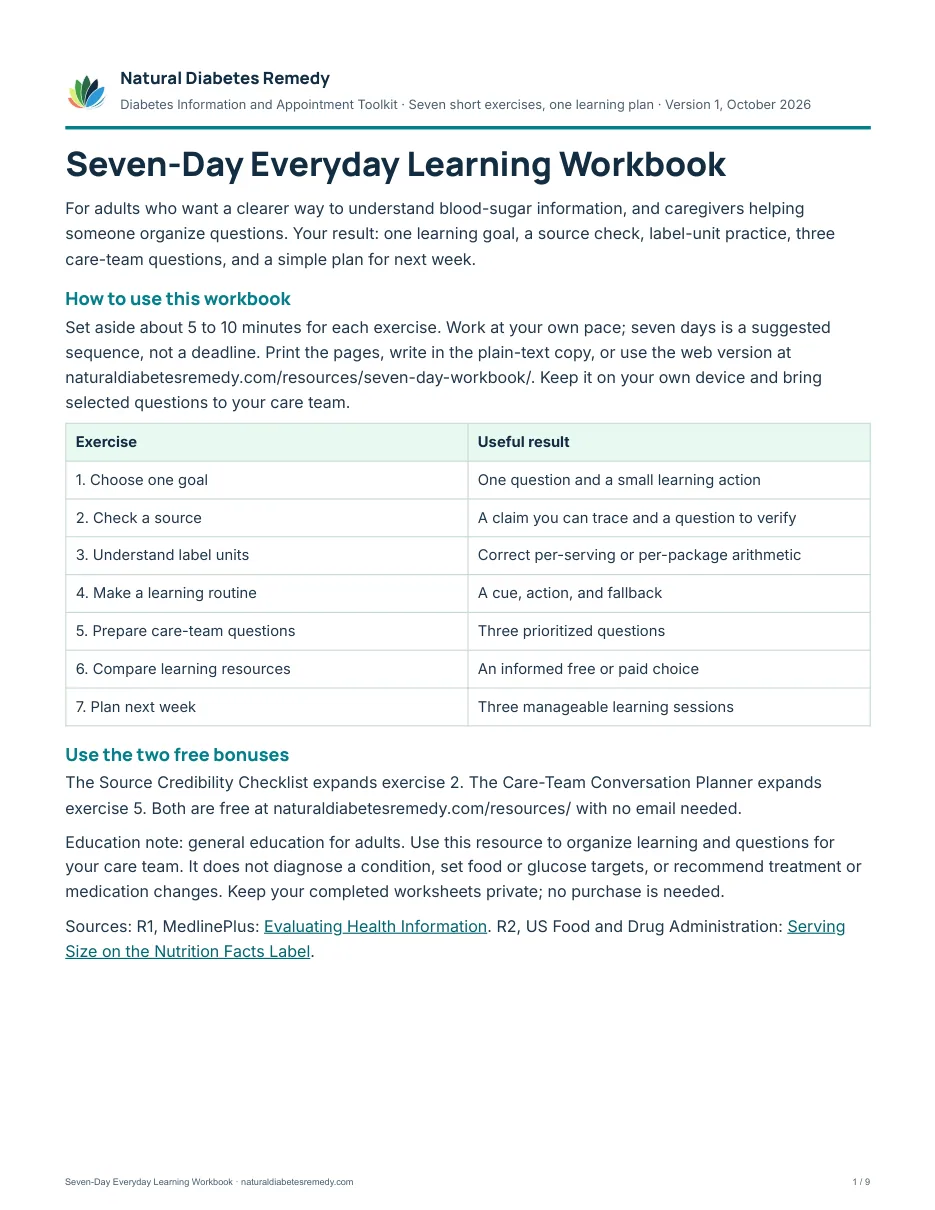
For adults who want a clearer way to understand blood-sugar information, and caregivers helping someone organize questions. Your result: one learning goal, a source check, label-unit practice, three care-team questions, and a simple plan for next week.
How to use this workbook
Set aside about 5 to 10 minutes for each exercise. Work at your own pace; seven days is a suggested sequence, not a deadline. Print the pages, write in the plain-text copy, or use the web version at naturaldiabetesremedy.com/resources/seven-day-workbook/. Keep it on your own device and bring selected questions to your care team.
| Exercise | Useful result |
|---|---|
| 1. Choose one goal | One question and a small learning action |
| 2. Check a source | A claim you can trace and a question to verify |
| 3. Understand label units | Correct per-serving or per-package arithmetic |
| 4. Make a learning routine | A cue, action, and fallback |
| 5. Prepare care-team questions | Three prioritized questions |
| 6. Compare learning resources | An informed free or paid choice |
| 7. Plan next week | Three manageable learning sessions |
Use the two free bonuses
The Source Credibility Checklist expands exercise 2. The Care-Team Conversation Planner expands exercise 5. Both are free at naturaldiabetesremedy.com/resources/ with no email needed.
Education note: general education for adults. Use this resource to organize learning and questions for your care team. It does not diagnose a condition, set food or glucose targets, or recommend treatment or medication changes. Keep your completed worksheets private; no purchase is needed.
Sources: R1, MedlinePlus: Evaluating Health Information. R2, US Food and Drug Administration: Serving Size on the Nutrition Facts Label.
Exercise 1. Choose one learning goal
Pick one question you want to understand better. Make it small enough to explore in one short session. This is a learning goal, not a target for a glucose reading or a treatment change.
Instructions
- Choose one topic: checking an article, understanding label units, or preparing an appointment question.
- Write the question in your own words. Choose a credible starting resource and a time you can realistically use.
- Define success as something you can do or explain after the session.
Worked example
Illustrative example: "I want to understand whether label information is per serving or per package. After tea on Tuesday, I will read the FDA serving-size guide for five minutes. Success means I can point to serving size and servings per container on one label."
Source R2, US Food and Drug Administration: Serving Size on the Nutrition Facts Label.
Exercise 2. Check a health information source
Use one article you are considering. MedlinePlus recommends asking questions about health information and discussing its relevance with a health professional. The checklist below helps you organize that check. [R1]
Instructions
- Identify the publisher or author, review date, and cited source for one important claim.
- Notice whether the page is selling something and whether that relationship is explained.
- Write down a question that remains unresolved. A polished page alone does not establish that a claim is reliable.
Worked example
Illustrative example: a page names an author and date but promises "certain results for everyone" without linking evidence. Record "no supporting source found for this promise" and keep the claim unresolved. Use the free Source Credibility Checklist for a fuller review.
Source R1, MedlinePlus: Evaluating Health Information.
Exercise 3. Understand label units
Start with serving size and servings per container. Nutrition information is usually per serving; some labels also show per-package amounts. The listed serving size is not a recommendation of how much to eat. [R2]
Instructions
- Find the serving information on a label. Copy the units as printed.
- Confirm whether the number you are using is per serving or per package.
- For arithmetic practice, multiply a per-serving amount by the number of servings you are examining. Do not multiply a per-package total again.
Worked example
| Fictional practice label | Value |
|---|---|
| Serving size | 1 cup |
| Servings per package | 2 |
| Total carbohydrate per serving | 18 g |
| Arithmetic for the whole package | 18 g x 2 = 36 g |
These invented values demonstrate units only. They are not a recommended serving, food choice, or carbohydrate target.
Source R2, US Food and Drug Administration: Serving Size on the Nutrition Facts Label.
Exercise 4. Build a small learning routine
Connect the learning action to something you already do. Choose a fallback so a busy day does not require abandoning the whole plan.
Instructions
- Name a familiar cue, such as finishing breakfast or making tea.
- Choose one learning action and keep the resource easy to find.
- Write a smaller fallback action and a date to review whether the plan worked.
Worked example
Illustrative example: "After breakfast on Thursday, I will read one section of the FDA guide for five minutes and record one question. If time is short, I will open the guide and note its title. I will review this plan on Sunday."
A missed session is information for adjusting the plan. It is not evidence about your health or character.
Exercise 5. Prepare three care-team questions
Use your learning notes to ask clearer questions. Bring this page to a planned conversation with your care team. Use the separate Care-Team Conversation Planner when you want more room for answers and follow-up.
Instructions
- Write the learning question that matters most to you first.
- Add two questions about where to learn next and whom to contact for clarification.
- Leave space for the answers. Check your understanding by repeating the agreed next step in your own words.
Worked example
Illustrative questions: "Which learning resource fits my current care plan?" "Who can help me understand food-label information in my situation?" "What should I learn next, and whom should I contact if I am confused?" No answers are invented here.
Do not send diagnoses, medication lists, glucose readings, or symptoms to a marketing email address. Use your care team's established communication channel.
Exercise 6. Compare learning resources
You can make progress with free resources. If you consider a paid product, compare the actual task, sample, access terms, and support before deciding.
Instructions
- Choose two learning resources. At least one may be a free public guide.
- Use the same criteria for both; write "not stated" when information is missing.
- Choose the resource that fits your learning task. A purchase is optional.
| Compare | Resource A | Resource B |
|---|---|---|
| Name and format | ||
| Task it helps me complete | ||
| Sample and source information | ||
| Time and access length | ||
| Price and recurring charge | ||
| Support and refund terms | ||
| Personal information requested |
Worked example
Illustrative example: a paid four-week course might add repeated practice and learning support. If a free resource already covers your task, keeping the free option is a complete and valid choice.
Exercise 7. Plan three learning sessions
Use what you learned to plan a manageable next week. You can repeat these exercises without buying anything.
Instructions
- Choose three short sessions. For each, name a cue, a resource, and one action.
- Mark a session complete only when you do the learning action.
- At your review date, keep, reduce, or change the plan based on what happened.
| Session | Cue and learning action | Done |
|---|---|---|
| 1 | ||
| 2 | ||
| 3 |
Worked example
Illustrative plan: Monday after tea, check the author and date on one article. Thursday after breakfast, practice one label-unit calculation. Sunday afternoon, rewrite one care-team question. If a session is missed, use the smaller fallback from exercise 4.
Optional learning check: completed sessions divided by planned sessions. For example, 2 / 3 = 67% after rounding. This describes follow-through on a learning plan; it is not a clinical measure.
Your learning recap
Keep the useful parts of this workbook and reuse them. Completing one useful exercise is progress even if you do not finish the whole sequence.
Keep learning for free
Repeat any exercise with a new question. The Source Credibility Checklist and the Care-Team Conversation Planner at naturaldiabetesremedy.com/resources/ extend exercises 2 and 5, with no email needed. If you ever consider a paid course, use exercise 6 to compare it with free options first. The workbook stays useful on its own.
Sources: R1, MedlinePlus: Evaluating Health Information. R2, US Food and Drug Administration: Serving Size on the Nutrition Facts Label.
Prefer paper? Standard PDF · Large-print PDF · Plain text
Want the printable files too?
The free toolkit adds the label practice, caregiver pack, 30-day planner and glossary, with large-print and text versions.
Immediate access after your request. Follow-up emails are optional.