
Free open-access resource
Source Credibility Checklist
Check who wrote a health claim, where its support comes from and what remains unclear.
About 105 KB. Opens in any PDF reader or browser. No purchase needed.
Start with one article and one claim.
1. Choose one claim
Pick one article and one sentence from it. Keep the question small enough to check.
2. Follow the information
Go through the eight checks. Mark a check only when you can actually locate the detail.
3. Keep a next step
Record what is missing, then choose an action: another source, a care-team question, or both.
An unchecked item means “not verified,” not automatically “false.” This is a screening aid, not a medical evidence rating.
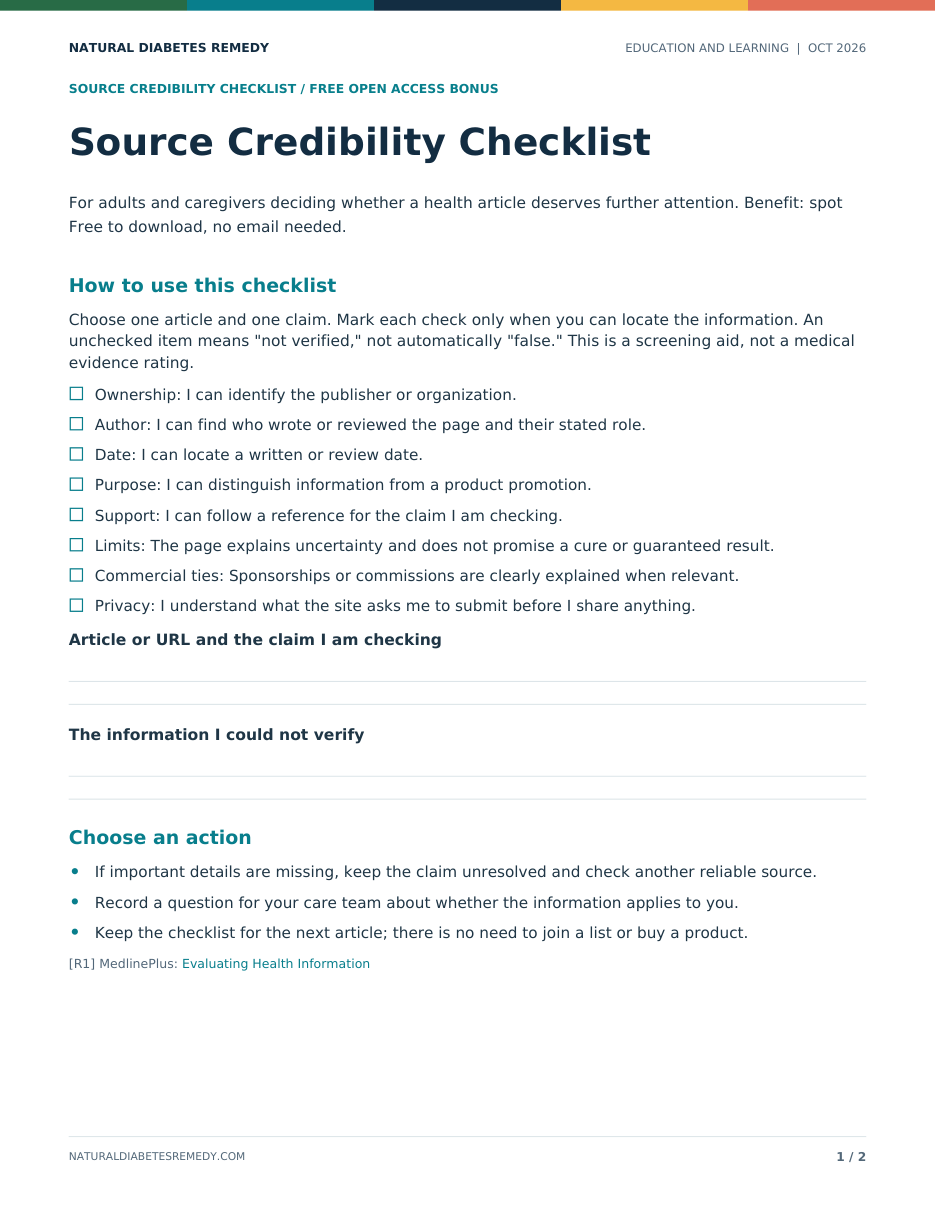
The complete checklist
Eight checks before you rely on a claim.
This is the full text of page 1. Use your downloaded or printed copy to record what you can verify.
| Check | Mark it when you can say… |
|---|---|
| 1. Ownership | I can identify the publisher or organization. |
| 2. Author | I can find who wrote or reviewed the page and their stated role. |
| 3. Date | I can locate a written or review date. |
| 4. Purpose | I can distinguish information from a product promotion. |
| 5. Support | I can follow a reference for the claim I am checking. |
| 6. Limits | The page explains uncertainty and does not promise a cure or guaranteed result. |
| 7. Commercial ties | Sponsorships or commissions are clearly explained when relevant. |
| 8. Privacy | I understand what the site asks me to submit before I share anything. |
Record in your copy: the article or URL and the claim you are checking, and the information you could not verify.
Choose an action.
- If important details are missing, keep the claim unresolved and check another reliable source.
- Record a question for your care team about whether the information applies to you.
- Keep the checklist for the next article. There is no need to join a list or buy a product.
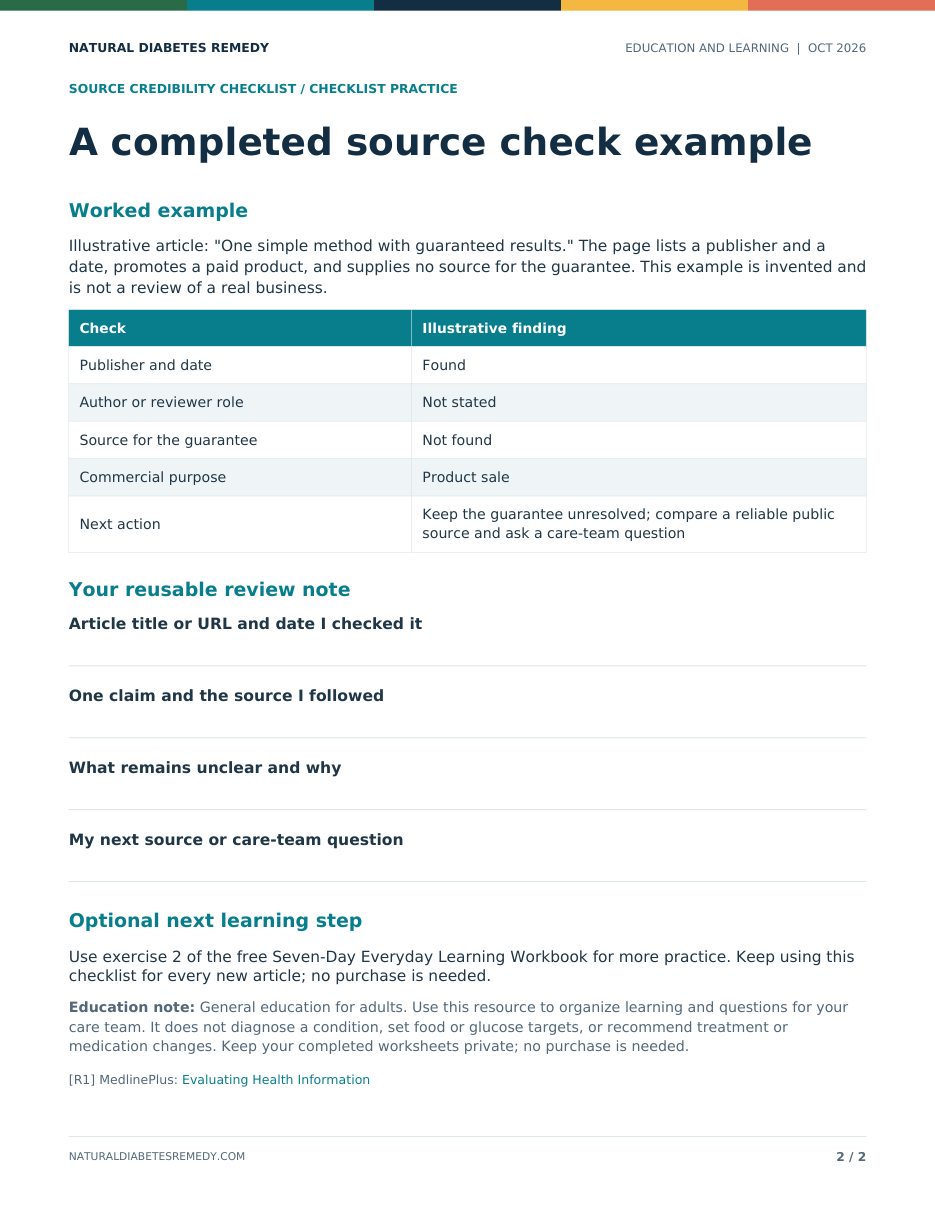
Your reusable review note.
Page 2 gives you space to write:
- Article title or URL, and the date you checked it
- One claim and the source you followed
- What remains unclear, and why
- Your next source or care-team question
- An optional next learning step
Illustrative example · invented article
Put the checklist into practice.
“One simple method with guaranteed results.”
This headline is invented for practice. The made-up page lists a publisher and a date, promotes a paid product and gives no source for its promise. It is not a review of a real business.
| Check | Illustrative finding |
|---|---|
| Publisher and date | Found |
| Author or reviewer role | Not stated |
| A source that supports the promise | Not found |
| Commercial purpose | Product sale |
Findings for an invented page, shown to practice the method.
Next action: keep the claim unresolved. Compare a reliable public source and record a question for your care team.
Page previews
See both pages before you download.
Download the checklist.
Free, with no email or account. Print it, or add notes in a PDF reader that supports annotation. Nothing you write in it reaches us.
2 pages, about 105 KB.
Keep building your learning skills.
More practice in the free workbook
Exercise 2 adds space to explore a source and plan your next question.
Read the source-checking guide
Before you trust a health article, check one claim: a step-by-step walk-through.
Turn an unresolved claim into a care-team question with the free planner
A practical screening aid.
Use this checklist to spot missing information. It does not rate medical evidence or make personal health decisions. If a page sells a product for diabetes, take extra care. The FDA warns that some diabetes products are sold illegally and have not been evaluated or approved by the FDA. NCCIH reports that for most dietary supplements there isn’t evidence of a benefit for diabetes. Talk with your care team before trying any product.
General education only. This page helps you organize learning and questions. It is not medical advice and does not recommend a treatment, diet, medicine or blood-sugar target. Personal health decisions belong with your care team. Medical and educational disclaimer
Sources and editorial notes
- MedlinePlus (US National Library of Medicine), Evaluating Health Information, retrieved October 18, 2026.
- US Food and Drug Administration, Illegally Sold Diabetes Treatments, retrieved October 18, 2026.
- National Center for Complementary and Integrative Health, Diabetes and Dietary Supplements: What You Need To Know, retrieved October 18, 2026.
The worked example is invented. Not yet reviewed by a clinician. See our Editorial Policy, Review Methodology and Affiliate Disclosure.
Keep it for your next article.
Choose one claim, follow one source and record what you can verify. For more practice, the free workbook adds exercise 2.
Immediate download after your request. Follow-up emails are optional.