
Care-team conversations
Three doctor visit questions, one sheet, one next step.
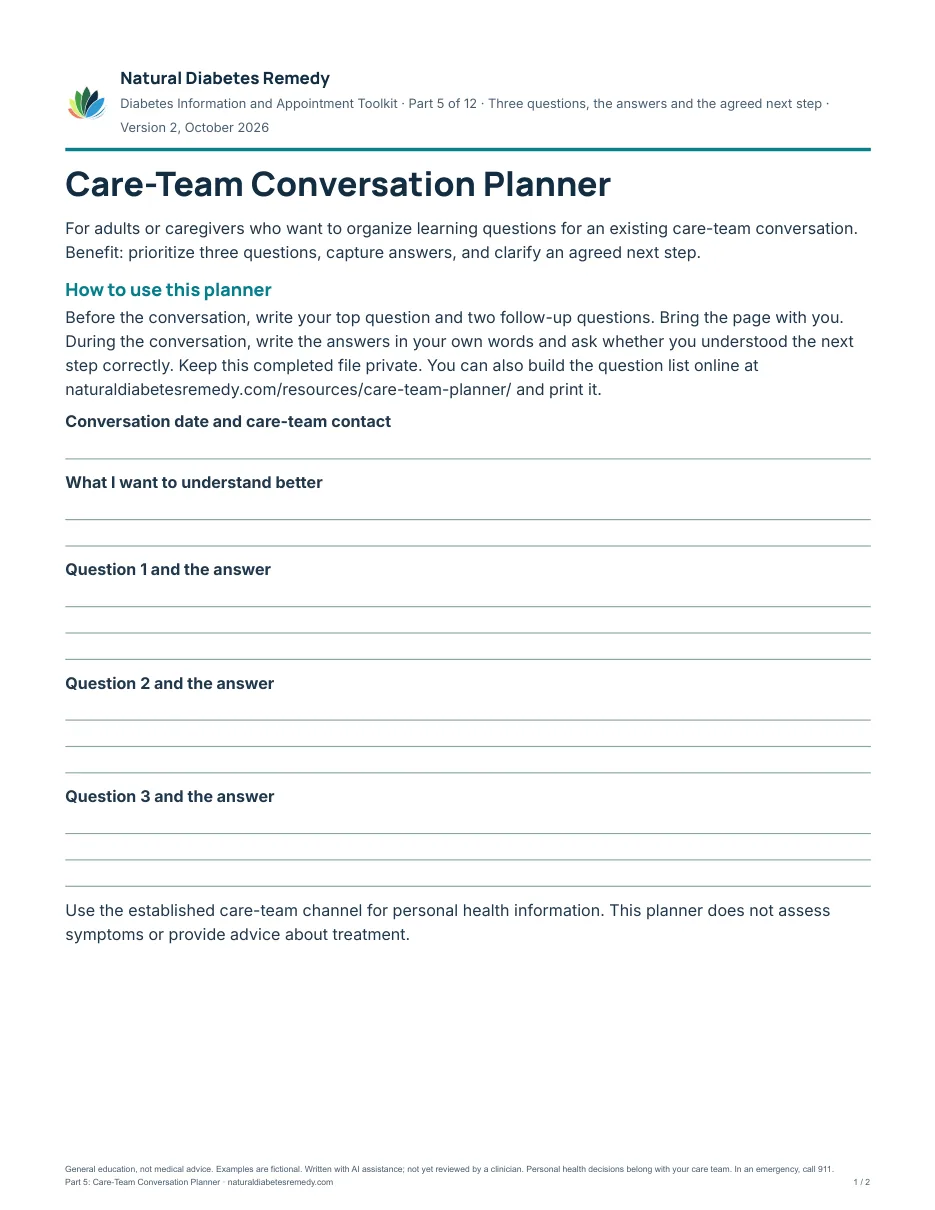
A single sheet split into before, during, and before you leave, with a box for the one agreed next step filled in before you walk out of the room.
Education only. Examples are fictional. Nothing here is medical advice.
The folder is still on the counter. You remember the parking garage and the nurse’s first name. What you can’t remember is what you were supposed to do next. There was a lot of advice, you nodded along, and by Thursday the plan is a blur.
That’s a paperwork problem before it’s a memory problem. Most of what you hear in an exam room arrives as speech, and speech doesn’t travel home well.
This page is one sheet, not a system. It splits into three blocks: before, during, and before I leave. You choose three questions ahead of time, write short answers in your own words, and fill in one agreed next step, with a who and a when, before you stand up.
This is education only. The examples are fictional, and your care team makes the decisions about your care.
Practice with the free toolkit.
The free Diabetes Information and Appointment Toolkit has twelve parts in one printable book: a start-here guide, the test words you will hear, questions about your results, programs to ask about, label practice, a question builder, a source check, a caregiver pack, a 30-day planner, a glossary, a seven-exercise workbook and a household week planner.
Free. No payment card. Download immediately after your request, then 4 short emails over about 10 days. Every email has an unsubscribe link.
One page, three blocks, one pen.
A single sheet beats a long journal. Fold a page in three, or use a notebook you already own. Label the blocks at home, because a blank page in a busy room is hard to fill.
| Block | When you fill it in | What goes in it |
|---|---|---|
| Before | A day or two ahead | Your top three questions, one line each |
| During | In the room | Short answers, in your own words |
| Before I leave | Standing up, before the door | One next step, who does it, when, and a fallback |
A practice layout, not a medical form. Your care team may want something different.
If you only fill in one block, fill in the third. A question can be asked again next time. A next step that nobody wrote down usually disappears.

Choose three questions, not ten.
Ten questions is a wish list. Three is a plan. Here is how to get from a crowded head to three lines.
1. Empty your head onto the page.
Set a timer and write every question you have, in any order. Do not edit yet.
2. Keep the three that would change your week.
For each question ask: if I knew the answer, would I do something differently in the next two weeks? Put the rest on a second page for another visit.
3. Rewrite each one as a single line.
Start with What or How. If a question needs three lines, it is probably two questions.
These shapes work in many appointments:
- “What is the one thing you most want me to understand before the next visit?”
- “What should I understand about the numbers in my chart?”
- “Who should I call between visits if I have a question?”
- “Is there a page or handout you trust that I can read on this?”
| My question | The answer, in my own words |
|---|---|
| write question 1 | leave blank until the visit |
| write question 2 | leave blank until the visit |
| write question 3 | leave blank until the visit |
A blank sheet for your own notes. It is not a medical form and it does not record results.
A new doctor needs a different three.
First visits fill up with introductions and forms. Ask these, and bring a written list of your medicines.
- What do you most want to know about my history that is not in my records?
- Which of my medicines are you keeping the same, and which do you want to review?
- How do I reach the office between visits, and what do I do if I cannot get through?
Ask the pharmacist for a printed medicine list. Photos of the labels are a fallback, but paper is easier to hand over. Write the answers beside the questions before you leave the room.
Write the short version, in your own words.
You are not taking minutes. Write just enough that the sentence still means something on Thursday.
- Write the short version of each answer, not every word.
- If an answer is not clear, say so once: “If I told my sister, I would say it this way. Is that right?”
- Turn the sheet around so your clinician can read the three questions.
- Leave one empty line under each answer. Something often gets added at the door.
Fill the next-step box before you leave.
This is the part most people skip, and the part that does the work. Before you stand up, write five short lines.
| The one next step | one step, not five |
|---|---|
| Who does it | me, or who else |
| When | a day or a week, not a maybe |
| If that does not work | the fallback |
| Who I call with a question | office, line, or portal |
A practice layout, not a medical form. Fill it in with your care team, not from this page.
Read it back once: “So the next step is this, I am doing it by then, and I call here if I get stuck. Did I get that right?” Ten seconds gives you a shared plan instead of a remembered one.
If the step does not happen, that is information for adjusting the plan, not a failure. Write what got in the way on the same sheet and bring it to the next visit.

A filled sheet, start to finish.
Here is what the three blocks look like when they are finished. Every detail below is invented for practice.
Before. Three questions:
- What is the one thing you most want me to understand before my next visit?
- Who do I call between visits if I have a question?
- I keep seeing bottles that promise to end diabetes. What should I check before I buy anything?
During, in my own words: we looked at one number together and I should bring my notes next time; call the office line first, and the pharmacist for medicine questions; show the label to the pharmacist before buying, and talk to the office before changing any medicine.
Before I left: one next step was to put the label, the handout, and my three questions into one folder. Who: me. When: this weekend. Fallback: leave the folder by the door with the appointment card. Who I call: the office line, then the pharmacist.
Fictional practice example. Not a real patient, not a real clinician, and not a recommendation for your care. It shows the shape of the sheet, not what your answers should say.
If a product promises to end diabetes, write one question.
This is the fear worth naming. A product promises a lot, the price is real, and you are the one who decides whether to trust it.
The National Center for Complementary and Integrative Health (NCCIH) says the FDA warns about products for diabetes that seem too good to be true, including products that claim they can replace your diabetes medicine. NCCIH says these products are marketed illegally, that some are harmful in themselves, and that all are harmful if used in place of effective treatment. NCCIH also notes some dietary supplements have side effects, and some can be serious.
Copy the exact promise, note the date, and add one line to your sheet: “I saw this product and this is what it says. What should I know before I try it?” The Source Credibility Checklist gives you eight checks for any health claim and opens without an email address.
Why this site hands you a sheet, not a remedy.
You may have arrived looking for holistic options and found a page about questions. That can feel like homework when your week is already full, and it is fair to be wary of free health pages that turn into sales pitches.
Here is the honest version. This site is education. It does not sell supplements, name products, or tell you what to take. No affiliate links are active today. What it can do is help you carry three questions to someone who knows your medicines and your history.
Test it cheaply. The Care-Team Conversation Planner and the Source Credibility Checklist are free PDFs that open without an email address. The seven-day workbook is also free and asks for a first name and an email so it can be sent. Nothing asks for health details, and you are asked not to send them.
Pages are written by the Natural Diabetes Remedy editorial team. The bar at the top shows the date and the review status, and no page has had clinical review yet. The Editorial Policy explains how that works. If you would rather use a bound notebook than a folded sheet, the appointment notebook guide lists features to check and names no products.
Questions people ask about doctor visit questions.
What questions should I ask at a first diabetes appointment?
Pick three, not ten. Useful shapes: what is the one thing you most want me to understand before the next visit; what should I understand about the numbers in my chart; who do I call between visits; and is there a handout you trust. Write the answers in your own words while you are still in the room. This page is education only.
I am seeing a new doctor. What should I ask at the first visit?
Ask what they most want to know about your history that is not in your records, which medicines they are keeping the same and which they want to review, and how you reach the office between visits. Bring a written list of your medicines, and ask a pharmacist for a printed one if that is easier.
How do I remember the answers after I leave?
Fill in the next-step box before you stand up: the step, who does it, when, a fallback, and who to call with a question. Read it back in your own words and ask whether you got it right.
Do I need an email address to use your tools?
No. The Care-Team Conversation Planner and the Source Credibility Checklist open without an email address. The seven-day workbook asks for a first name and an email so it can be sent to you. Nothing asks for health details.
A product promises to end diabetes. Where do I check it?
Write the exact words and the date you saw them, then ask your pharmacist or care team. NCCIH notes the FDA warns about diabetes products that seem too good to be true, that they are marketed illegally, and that they are harmful if used in place of effective treatment.
General education only. This page helps you organize learning and questions. It is not medical advice and does not recommend a treatment, diet, medicine or blood-sugar target. Personal health decisions belong with your care team. Medical and educational disclaimer
Sources and editorial notes
- National Center for Complementary and Integrative Health, Diabetes and Dietary Supplements: What You Need To Know, retrieved October 18, 2026.
- MedlinePlus, Diabetes, retrieved October 18, 2026. MedlinePlus gathers public resources on living with diabetes, including material about your diabetes care team.
- Question layout follows the three-question page in our free Care-Team Conversation Planner.
Examples are illustrative and fictional. Not yet reviewed by a clinician. See our Editorial Policy, Review Methodology and Affiliate Disclosure.
Fill the sheet before the next visit.
Three questions, three answers, one next step with a who and a when.
PDF. No email needed.
Keep the next visit simple too.
Prepare Three Questions for Your Care Team
Prioritize questions and record a next step.
Care-Team Conversation Planner
Prepare three questions and record your next step. Free online or as a PDF.
Appointment Notebooks for Care-Team Questions
Question, answer and next-step fields to check.