
Supplement checks
The label says natural. Check it against FDA warnings.
One product, one public warning page, one dated note, and one question for your care team.
Education only. No products named. No email needed for the free checklist.
You turn the bottle around and look for something you can check. The front says natural. The back lists ingredients you do not recognize. You have read that some supplements can have side effects or interact with medicines. You do not want to ignore this until it becomes a bigger problem. You also do not want to spend money on a bottle that makes a big promise.
That is a fair place to start. You are not being asked to become a researcher. This page gives you one small task: pick one supplement you have already seen, look it up on the FDA’s Illegally Sold Diabetes Treatments page, note the date, and write one question for your care team.
This is education, not a remedy. It names no products and sells nothing. The goal is a dated note you can bring to your doctor or pharmacist, not a decision made from an ad.
Two public agencies publish warnings you can read yourself.
The National Center for Complementary and Integrative Health (NCCIH) says a few dietary supplements have weak evidence of a possible benefit. But the studies are limited in size and differ in who took part, what was in the product, and how long it was used. NCCIH says this leads to no clear conclusions. For most supplements, it says there is not evidence to support a beneficial effect on diabetes or its complications.
NCCIH also says some supplements may have side effects, and some can be serious, such as kidney damage. It notes that the FDA warns about diabetes products that seem too good to be true. These products are marketed illegally. Some are harmful in themselves. All are harmful if people use them instead of effective treatment.
The word natural is not a safety check. It does not tell you what is in the product, what was studied, or whether it is safe with your medicines.
Both agency pages are free to read. Neither asks you to sign up. Open them in a second tab so you can compare them with the label in your hand.

Five steps, one sitting.
Work through these with one product in front of you. Five minutes is enough for the first three steps.
1. Pick one product you have already seen.
A bottle, an ad, or a product a friend mentioned. Write the name exactly as it appears on the front, who sells it, and where you saw it.
2. Open the FDA page and search the name.
Use the link in this article. Then use your browser’s find function: Ctrl and F on Windows, Cmd and F on a Mac. Search the product name, then search the company name, and note what you find or that you found nothing.
3. Note the date and what you found.
Write the date you checked. Write named on the FDA page or not listed. Add a few words about what the page says if it is named.
4. Copy the promise words.
Copy the exact phrase that made you pause, in quotation marks. Examples include natural, blood sugar support, or replaces your diabetes medicine.
5. Write one question for your care team.
One question, in your own words. Leave space under it for the answer.
Read the FDA page as a warning, not a test.
Read the top of the page first. It is a consumer warning about diabetes products sold illegally. It is not a shop, a rating site, or an approval list.
Search the product name, then search the company name, and note what you find or that you found nothing. If you find an entry, copy a few words of the reason given.
If you find your product, try not to panic. Do not stop or change a prescribed medicine on your own. Write down what you found and show it to your pharmacist or care team.
If you find nothing, write not listed and the date. That is an honest result. It is not a safety clearance.
Write five lines you can keep.
Five lines are enough. Use a notes app or the back of an envelope. For the question itself, write it on the free Care-Team Conversation Planner, which gives you space for the answer and the agreed next step.
| What to record | My note |
|---|---|
| Product name, seller, and where I saw it | write it here |
| Date I checked the FDA page | date |
| What I found, or not listed | note it |
| Exact promise copied from the label or ad | copy the words |
| My one question for my care team | question |
Write only what you checked and when. This table is not a judgment about whether a product works.
A label phrase is not a safety check.
Words like natural, herbal, and blood sugar support are chosen by the seller. The phrase is chosen by the seller. Copy it exactly as it appears, then ask your pharmacist what is known about the product. It does not tell you what the product contains, what was studied, or whether it is safe with your medicines.
The loudest warning sign is a product that says it can replace your diabetes medicine. NCCIH notes that the FDA warns about these products and that they are marketed illegally.
You keep seeing an ad for a bottle labeled “Herbal Glucose Support.” The ad says it is natural and that you can stop your diabetes medicine.
- Product and source: “Herbal Glucose Support,” ad on a social post.
- Date I checked: write the date.
- What I found on the FDA page: named, or not listed.
- Promise copied: “you can stop your diabetes medicine.”
- My question: “Could anything in this product interact with my medicines?”
Fictional practice label only. It is not a real product. Nothing here says whether any supplement works. This is the note, not an answer.

Turn the note into one question.
A question that includes what you found is easier to answer than “are supplements okay?”
- “I looked up this product on the FDA warning page on this date and found this. Is there anything I should know before I try it?”
- “The label says blood sugar support. Could anything in this product interact with the medicines I take?”
Bring the note to your next visit, or ask a pharmacist sooner. Our guide to preparing three questions for your care team shows how to rank them and record the answers. The Care-Team Conversation Planner gives you space for the answer and the agreed next step.
Keep the note private. Please do not send product names, medicine lists, or results to us. We cannot advise on them, and we do not ask for them.
A warning list is not an approval list.
People search for FDA approved diabetes supplements. The page you just used is not that. It is a warning list about products sold illegally. It does not certify any supplement as safe, effective, or right for you. A product that is absent from it has not been checked and cleared for you.
None of this says every supplement is bad. It says what to do before you spend money: copy the promise, look up the product, note the date, and ask one question of someone who knows your medicines.
Spot common supplement scams.
Dietary supplement scams often share a few shapes. The loudest is a promise to replace your diabetes medicine. NCCIH notes that the FDA warns these products are marketed illegally.
Other practical reasons to slow down: pressure to buy today, stories from people you cannot check, a seller who will not name a company, and a label that does not list the amount of each ingredient.
Save the ad or label. Write the date. Ask before you buy.
Why this site asks you to check, not buy.
You may have come looking for holistic options and found a lookup task instead. That can feel like homework when your week is already full. The honest position: this site is education. It does not sell supplements, name products, or tell you what to take. It cannot tell you what is safe for your body. What it can do is show a check you can finish in a few minutes and bring to someone who knows your medicines.
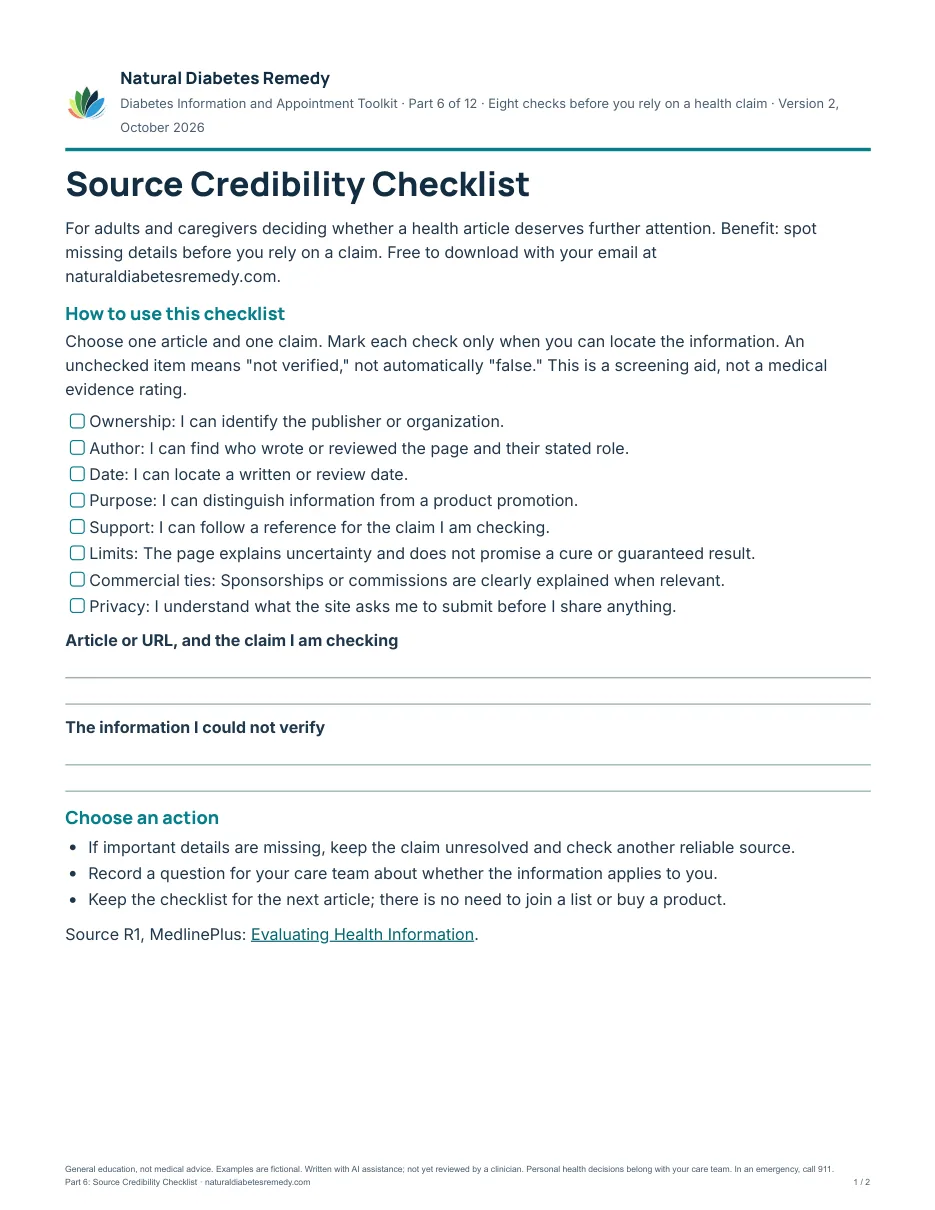
No email is required to open the Source Credibility Checklist or the Care-Team Conversation Planner. You can try the method before you decide whether it is worth your time. The checklist lists eight checks for any health claim, including purpose, support, limits, and commercial ties. The article on checking one claim before you trust a health article walks through a similar check.
Pages are written by the Natural Diabetes Remedy editorial team. The bar at the top shows the date and the review status. None of our pages has had clinical review yet, and we say so on the page rather than implying otherwise. You can read how that works in our Editorial Policy.
And if this sounds like homework: it is one lookup, once, for one product. Not a program and not a purchase.
Questions people ask about supplement checks.
Is this an FDA approved diabetes supplement list?
No. The page linked here is a warning list about diabetes products sold illegally. It is not an approval list. A product that is not on it has not been checked and cleared for you. Ask your pharmacist or care team about a specific product.
What if an ad says a supplement can replace my diabetes medicine?
NCCIH notes that the FDA warns about diabetes products that claim to replace diabetes medicine, that these products are marketed illegally, and that they are harmful if used instead of effective treatment. Save the ad, note the date, and talk with your care team before you buy or take anything.
What does blood sugar support mean on a supplement label?
It is wording chosen by the seller. It does not tell you what the product contains, what was studied, or whether it is safe with your medicines. Write the exact phrase down and ask your pharmacist.
I could not find the product. Is it safe then?
No. The page is a warning list, not an approval list. Write not listed with the date you checked, and ask your care team or pharmacist about the product itself.
What are common dietary supplement scams?
A common shape is a product that says it can replace your diabetes medicine. NCCIH notes the FDA warns that such products are marketed illegally. Practical reasons to slow down also include pressure to buy today, stories you cannot check, a seller who will not name a company, and a label that does not list amounts.
Does this site sell supplements?
No. This page names no products and sells nothing. No affiliate links are active on the site today. The Source Credibility Checklist opens without an email address.
General education only. This page helps you organize learning and questions. It is not medical advice and does not recommend a treatment, diet, medicine or blood-sugar target. Personal health decisions belong with your care team. Medical and educational disclaimer
Sources and editorial notes
- National Center for Complementary and Integrative Health, Diabetes and Dietary Supplements: What You Need To Know, retrieved October 18, 2026.
- US Food and Drug Administration, Illegally Sold Diabetes Treatments, retrieved October 18, 2026.
- Question phrasing follows the three-question layout in our free Care-Team Conversation Planner.
Examples are illustrative and fictional. Not yet reviewed by a clinician. See our Editorial Policy, Review Methodology and Affiliate Disclosure.
Do the lookup once.
Open the FDA page, search one product, and write the date. That is the whole task.
Free. No sign-up.
Keep checking, one claim at a time.
Prepare Three Questions for Your Care Team
Prioritize questions and record a next step.
Source Credibility Checklist
Check who wrote a claim and what supports it. Free online or as a PDF.
Before You Trust a Health Article, Check One Claim
Publisher, author, date, support and commercial ties.