
Learning & routines
Build a five-minute learning routine.
One question. A familiar cue. A small action you can adjust.
This guide is for adults and caregivers who want a small, steady way to learn about prediabetes or type 2 diabetes questions. Five minutes is a suggested timebox, not a rule. Choose a shorter session whenever you need to. The routine described here is a learning habit: reading, noting and asking. It is not a health measure, and it does not replace advice from your care team.
What you record is the learning action you completed. You do not record food, readings, medicines or symptoms in this routine. Those belong with your care team and the tools they recommend.
Choose one question.
A routine works best when each session has one small target. Pick something you can explore in a single sitting: a label term you keep seeing, the source behind an article, or a question you want to bring to your next appointment.
Write the question in your own words. Short is fine. If the question feels big, split it. “What do I need to know about food labels?” becomes “Is this label information per serving or per package?”
“How can I tell whether label information is per serving or per package?”
An invented question for practice. It does not suggest what anyone should eat.
Then pick one public starting point and keep its title or link where you can find it again.
| Learning task | Public starting point |
|---|---|
| Serving information | FDA, Serving Size on the Nutrition Facts Label |
| Checking an article | MedlinePlus, Evaluating Health Information |
| Finding a question | Care-Team Conversation Planner (free, no email needed) |
Choose one resource per session. You can rotate them across the week.
Turn one question into a learning plan.
The free Seven-Day Everyday Learning Workbook has seven short exercises: choose a goal, check a source, practice label units, prepare care-team questions and plan your next week.
Free. No payment card. Download immediately after your request. Follow-up emails are a separate, optional choice.
Pick a cue, an action and a fallback.
A cue is something you already do every day or every week. Tying the learning action to it means you do not have to remember a new appointment. Good cues are steady and easy to notice: finishing breakfast, making tea, sitting down after a walk, or waiting for the kettle.
The action is one specific learning step. “Learn about labels” is too vague to finish. “Read one section and write one question” has a clear end.
The fallback is a smaller version of the action for a busy or tiring day. It keeps the thread going without asking much. Opening the guide and noting its title counts.
| Part | What it means | Illustrative example |
|---|---|---|
| Cue | A familiar moment you already have | After breakfast on Thursday |
| Action | One learning step with a clear end | Read one section and write one question |
| Fallback | A smaller step for a busy day | Open the guide and note its title |
The fallback is a smaller action, not a failure. Record what you actually did, whichever version it was.
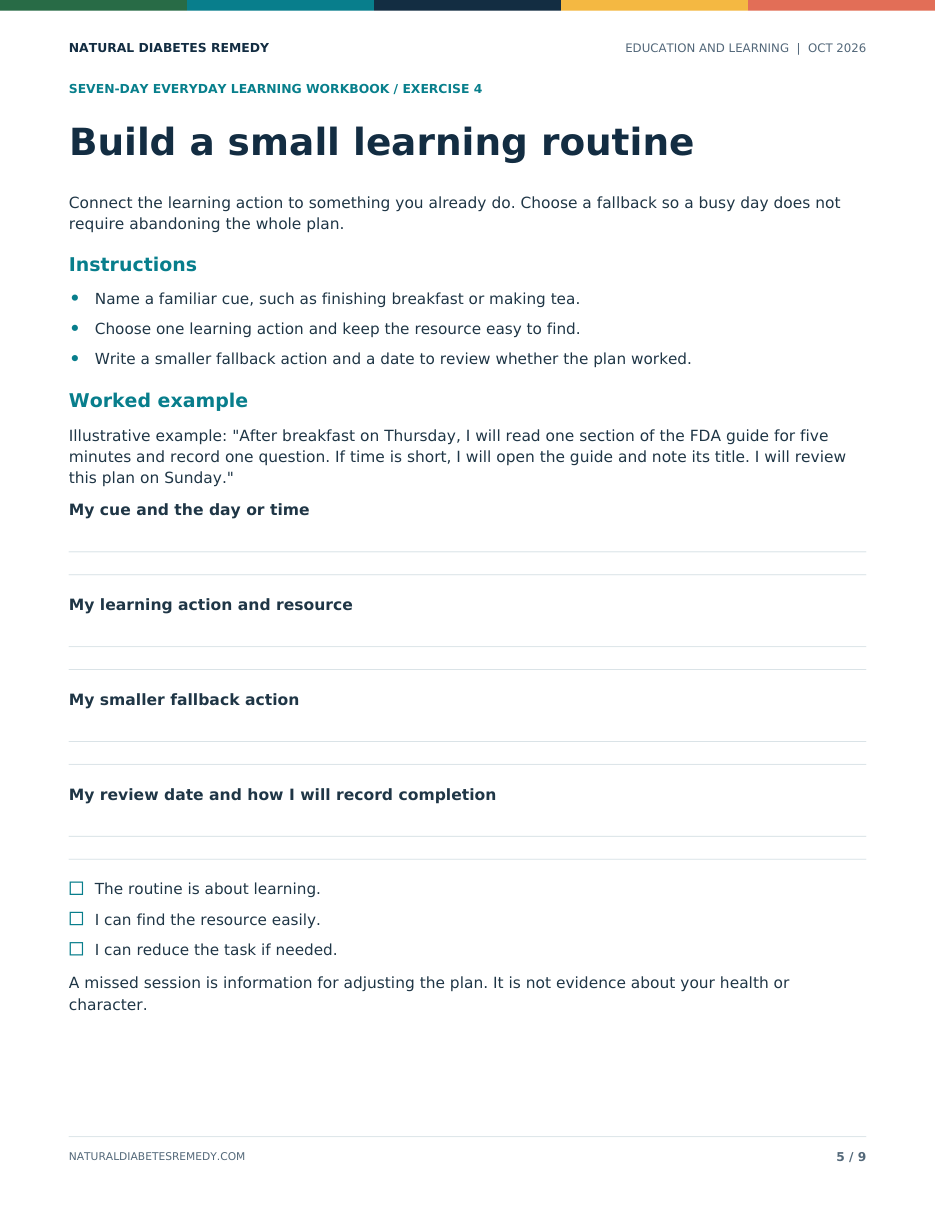
Exercise 4 of the free workbook, “Build a small learning routine,” has a space for each part: your cue and day, your learning action and resource, your smaller fallback, and a review date. It ends with three quick checks: the routine is about learning, you can find the resource easily, and you can reduce the task if needed.
Write a paper plan.
A plain sheet of paper is enough. Writing the plan down makes it easier to start, and it gives you something to look at during your weekly review. You do not need a special notebook, app or account.
| My question | Is this label information per serving or per package? |
|---|---|
| My resource | FDA serving-size guide |
| My cue | Thursday, after breakfast |
| My action | Read for five minutes; note one question |
| My fallback | Open the guide and record its title |
| My review | Sunday: keep, reduce or change the plan |
An invented learning example. Timing is flexible, and no health result is promised or implied.
If you like full sentences, the same plan fits on one line you can copy onto any sheet:
After my cue, I will my learning action using my resource. If time is short, I will my fallback. I will review on my review day.
No purchase, account or sign-up is needed. Keep the completed sheet private.
Review and adjust once a week.
Pick a review time, such as Sunday afternoon. Look at your sheet and ask three questions: Was the cue useful? Could I find the resource? What should I keep, reduce or change?
- I recorded the learning action I completed.
- I noted a fallback or a missed session separately.
- I kept one unresolved question for my care team.
Then make one change at most. Swap a cue that kept getting skipped. Shrink an action that felt too long. Move a question you could not answer onto your list for the next appointment.
A missed session is information for adjusting the plan. It says nothing about your health or your character.
When one routine feels settled, plan the next week. Exercise 7 of the workbook, “Plan three learning sessions,” gives you a small table for three sessions, each with a cue and one learning action, and a box to mark when you did the learning action. Its optional check (completed sessions divided by planned sessions) describes follow-through on a learning plan. It is not a clinical measure.
Choose a notebook only if it helps.
Many people are fine with loose paper. Some prefer a bound journal that keeps weeks together. If you are thinking about buying one, our guide to paper habit journals for learning routines explains what to check: page layout, legibility, size, binding and privacy. It names no products and has no affiliate links. If you are weighing paper against an app, read Paper or Digital Habit Tracking first.
General education only. This page helps you organize learning and questions. It is not medical advice and does not recommend a treatment, diet, medicine or blood-sugar target. Personal health decisions belong with your care team. Medical and educational disclaimer
Sources and editorial notes
- US Food and Drug Administration, Serving Size on the Nutrition Facts Label, retrieved October 18, 2026.
- MedlinePlus, National Library of Medicine, Evaluating Health Information, retrieved October 18, 2026.
- The cue, action and fallback method and the weekly plan are adapted from exercises 4 and 7 of our free Seven-Day Everyday Learning Workbook.
Examples are illustrative. Not yet reviewed by a clinician. See our Editorial Policy, Review Methodology and Affiliate Disclosure.
Keep learning, one step at a time.
Paper Habit Journals for Learning Routines
Layout, legibility, binding and privacy to check.
Paper or Digital Habit Tracking
What to record, trade-offs and a privacy checklist.
Before You Trust a Health Article, Check One Claim
Publisher, author, date, support and commercial ties.
Give your next question a place to start.
The free workbook brings learning goals, source checks and care-team questions together.
Immediate download after your request. Follow-up emails are optional.