
Getting started
Printable Food Log: One Line a Day, No App, No Sign-Up
One line a day on a card you print at home. No account, no sign-up, nothing sent anywhere.
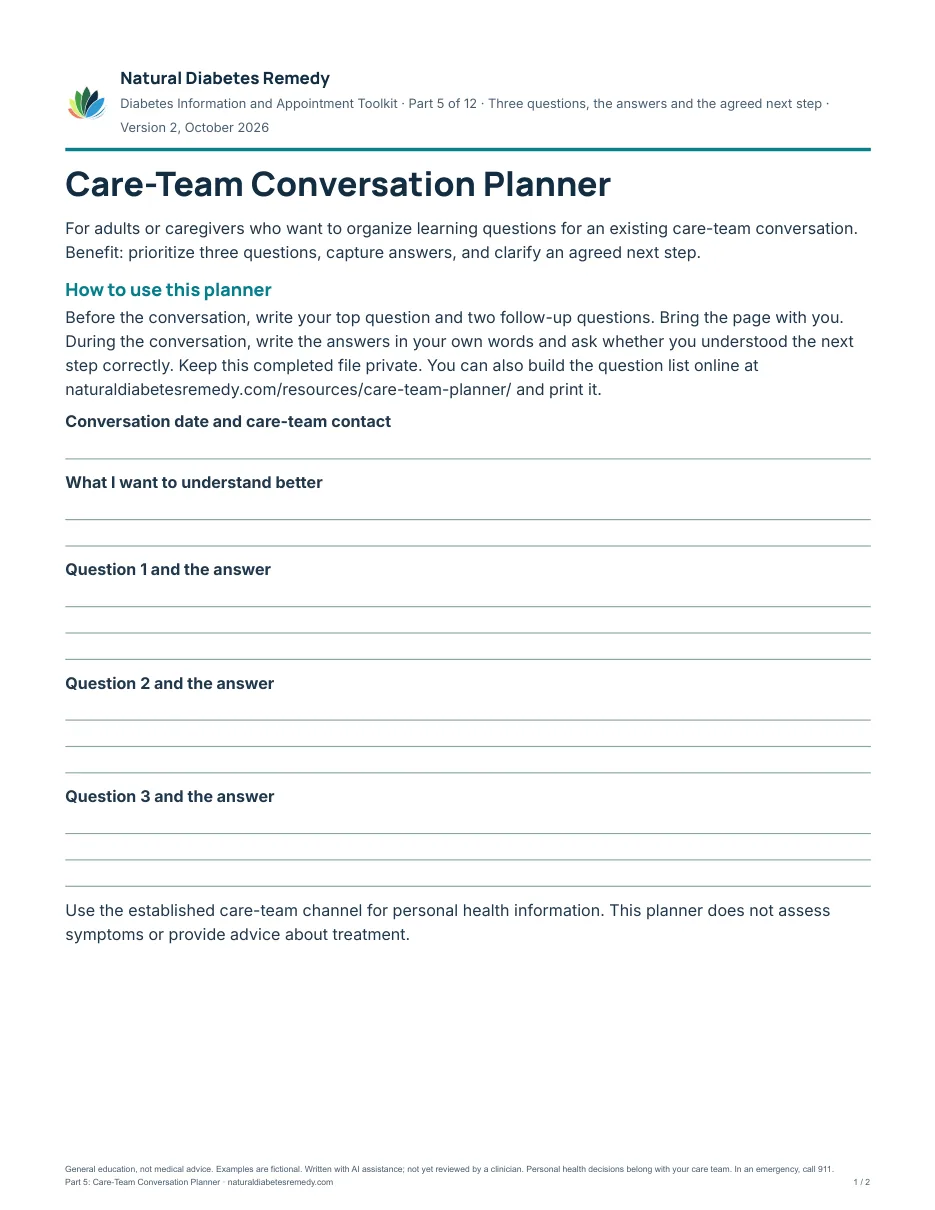
You want a record of what you eat without handing your breakfast to an app. So you buy a notebook, and the notebook sinks to the bottom of your bag. By day three, the log has quietly stopped.
This page is a smaller version of that idea. One line a day, on a card you print at home and keep in a pocket. No account. No sign-up. No app running in the background. Nothing you write reaches us, because paper does not send anything anywhere.
One honest note first. This is an education site, not a clinic. We do not sell a remedy and we do not promise one. What we can do is show you a five-minute way to keep a record you control, plus the questions to ask before any app sees it.
A log is a record, not a treatment. Bring what you notice to your care team rather than changing food, medicines or targets on your own.
Three fields are enough to start.
Most food logs fail because they ask for too much: every meal, every amount, a score at the end of the day. Start with one line and three fields.
| Field | What goes there | Illustrative line |
|---|---|---|
| Time | The rough time you ate | 12:20 p.m. |
| What | Your own plain words | Turkey sandwich, apple |
| One note | Something you noticed, or a question | Busy morning; ask about snacks |
Illustrative entries only. They are not a recommended meal, amount or eating pattern.
Notice what is missing. No calories, grams, ratings or goals. You are recording what happened, not grading it.
Labels work the same way. The FDA guide to the Nutrition Facts label says a serving size “reflects the amount that people typically eat or drink. It is not a recommendation of how much you should eat or drink.” A log reports. It does not prescribe.
Put the useful part in the note: “Meeting ran long, ate late.” “Ask about portions.” One short note travels better to an appointment than a wall of numbers.
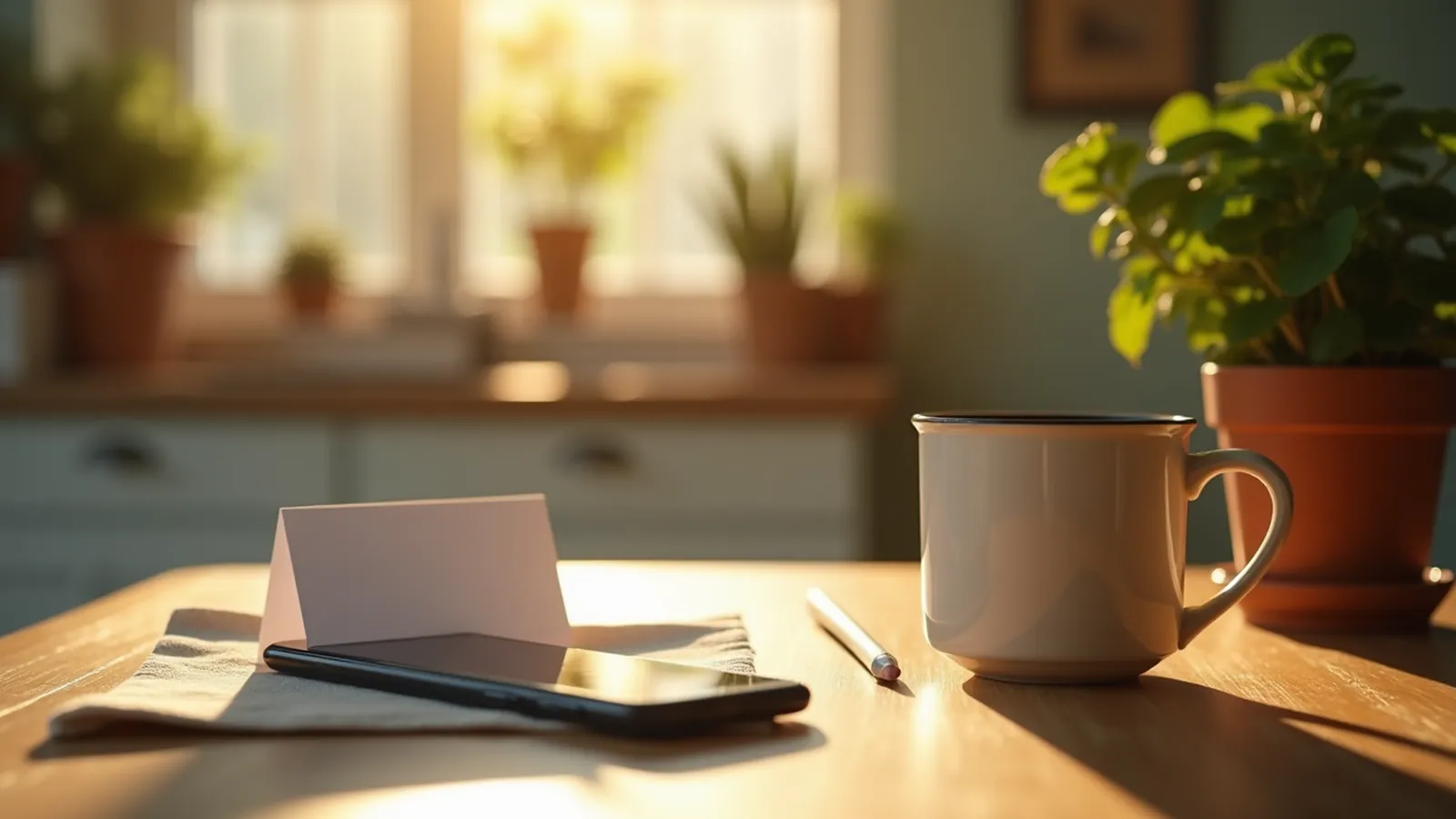
Print the card and keep it findable.
An index card works. So does a folded sheet or the back of an envelope. If you want a printed version, use your browser’s print option on the card below.
Daily log card
Day and date: write it here
Line 1: time · what I ate · one note
Line 2: time · what I ate · one note
Line 3: time · what I ate · one note
One question for my care team: write it here
Illustrative layout. Nothing you write on it is sent to us.
Four small habits keep a card from disappearing.
Make three copies.
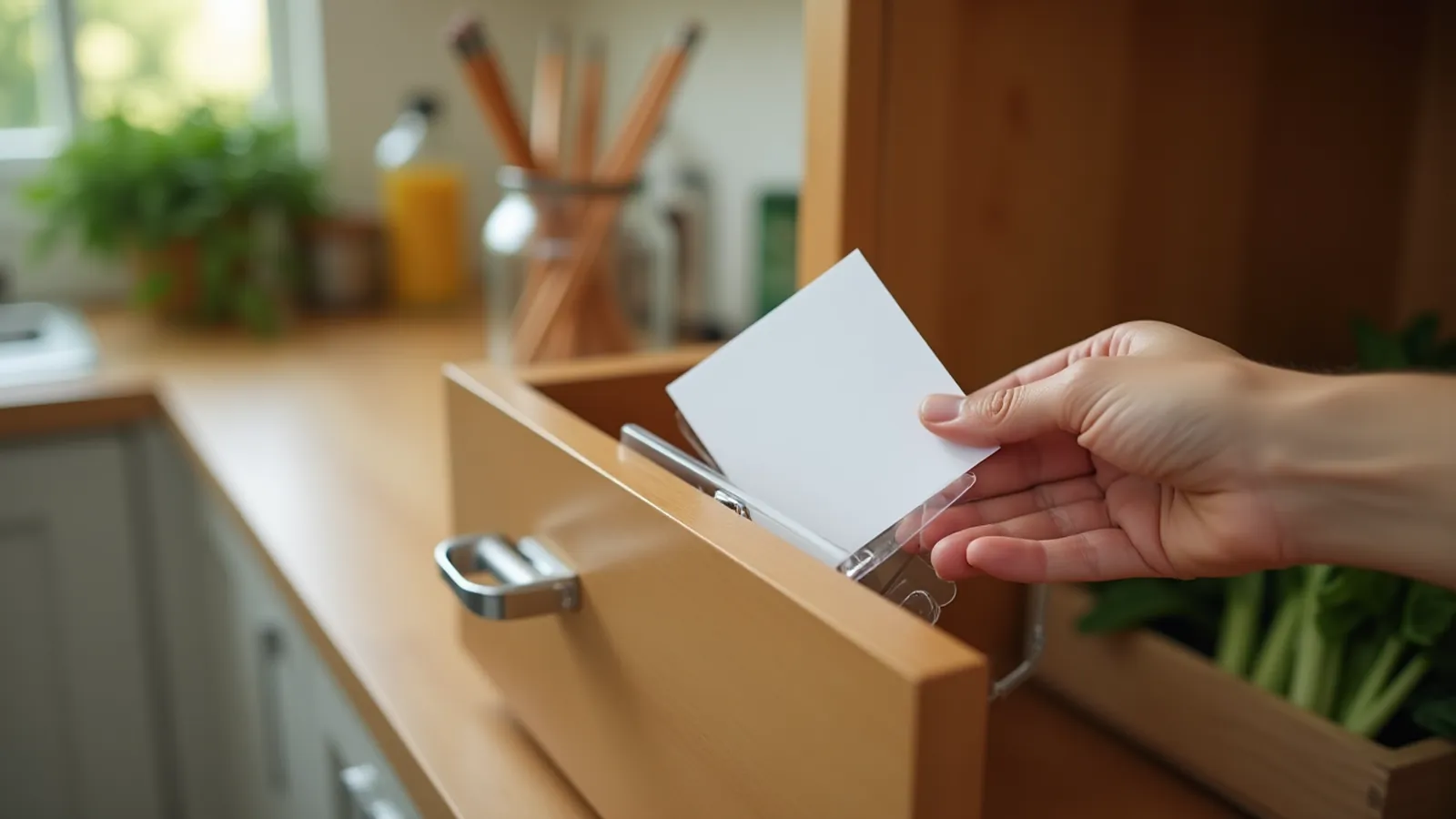
One for your bag, one for the kitchen, one for a drawer. Losing a card then becomes a small annoyance instead of the end of the log.
Write the day and date at the top.
One card per day. Seven cards make a week, and a week is enough to bring to an appointment.
Fill the line while the plate is still there.
One minute at the table beats twenty minutes of guessing at bedtime.
Decide where finished cards go.
An envelope, a folder, or the recycling bin after a week. Keep them somewhere you would not mind a family member seeing.
There is no streak to break and no countdown to beat. WCAG 2.2, the web accessibility standard, asks that content allow people enough time and let them adjust any time limit it sets (Success Criterion 2.2.1). A habit can follow the same idea. Keep the pace yours.
Ask three questions before you type anything.
If you would rather keep the log on your phone, that is fine. Ask any tool these three questions first. Our guide to digital habit planners uses the same checks and names no products.
What does it collect, and what does it share?
Search the privacy policy for words like share, advertising and third party. If you cannot find a policy, that is an answer too.
Does it need an account?
An account usually means your entries live on someone else’s computer. Some tools work fully offline. Know which one you are getting before week one.
What happens when you delete?
Can you export your entries? Does deleting the app delete the data, or only the icon? Look for a clear answer before you type anything private.
Choose an app with fewer fields.
A simple food log app should be simple to set up. If the first screen asks for a goal, a weight or a target, the app is doing more than recording. Fewer fields means less to maintain, and less to explain if someone else picks up your phone.
Look for a way to hide the target screens.
If you are searching for a food log app that doesn’t count calories, open its help pages and look for words like goal, nutrient, target and score. Some tools record text and time only. Others add targets quietly. See whether those screens can be switched off before you rely on the tool.
On an iPhone, the plainest option may already be there.
For many people, the simplest food log app for an iPhone is the notes app already installed. It needs no new account, and you can lock a note. Check your phone’s own help pages to see whether notes sync to a cloud account and how locking works on your model.
If you photograph a card, know whether your phone backs photos up to a cloud service. Paper and digital each carry trade-offs, and paper or digital habit tracking compares them without hype.
Bring a week of lines to your care team.
Seven cards give you something concrete to discuss. Read them the day before an appointment and write three short questions. The three-question method explains how to choose them. Exercise 5 of the free Seven-Day Everyday Learning Workbook, “Prepare three care-team questions,” walks through the same step.
The free Care-Team Conversation Planner has room for three questions, the agreed next step and who does it. It opens without an email address.
Please do not send your cards or health details to us. We do not ask for them, and we cannot give personal advice.
Why an education site talks about food logs.
You may have arrived looking for holistic options and found a page about index cards. That reaction is fair. We cannot treat anyone and will not pretend to. What we can do is help you check what you are told, and keep each task short enough to finish on a lunch break.
That is why label reading and source checks appear here instead of a product list. If you are weighing something that promises big results, read two public pages first: NCCIH’s page on diabetes and dietary supplements, which describes the evidence as limited and warns that some products are sold illegally with false claims, and the FDA’s page on illegally sold diabetes treatments. Talk with your care team before trying any supplement.
Nothing on this site is for sale today, and no affiliate links are active. If that changes, the Affiliate Disclosure and Privacy Policy change first. Our Editorial Policy is public, and the free Source Credibility Checklist opens without an email address if you want to check a page, including ours.
Questions readers ask.
What is a printable food log?
A card or page you print and fill in by hand. The version here is a one-line-a-day card: the time, what you ate, and one note. You can copy the layout by hand or print the page from your browser.
Is there a food log app that doesn’t count calories?
Some record text and time only. Others add targets and scores anyway. Check the help pages for words like goal, nutrient and score, then look at the privacy policy before you type anything you would not want shared. A paper card avoids the question.
Can I keep a food log on my iPhone without an account?
Often yes. A plain note you type into needs no new account, and many phones let you lock a note. Check whether notes sync to a cloud account and how locking works on your model.
Do I have to log every meal?
No. One line a day is enough to start, and a partial week still gives you something to bring to an appointment.
General education only. This page helps you organize learning and questions. It is not medical advice and does not recommend a treatment, diet, medicine or blood-sugar target. Personal health decisions belong with your care team. Medical and educational disclaimer
Sources and editorial notes
- US Food and Drug Administration, How to Understand and Use the Nutrition Facts Label, retrieved October 18, 2026.
- World Wide Web Consortium, Web Content Accessibility Guidelines (WCAG) 2.2, Success Criterion 2.2.1 Timing Adjustable, retrieved October 18, 2026.
- National Center for Complementary and Integrative Health, Diabetes and Dietary Supplements: What You Need to Know, retrieved October 18, 2026.
- US Food and Drug Administration, Illegally Sold Diabetes Treatments, retrieved October 18, 2026.
Examples are illustrative. Not yet reviewed by a clinician. See our Editorial Policy, Review Methodology and Affiliate Disclosure.
Keep the log small enough to keep.
Paper or Digital Habit Tracking
What to record, trade-offs and a privacy checklist.
Prepare Three Questions for Your Care Team
Prioritize questions and record a next step.
Paper Habit Journals for Learning Routines
Layout, legibility, binding and privacy to check.
Small enough to keep.
The free Care-Team Conversation Planner has space for three questions and the agreed next step. No email needed.
Immediate access after your request, then 4 short emails. Every email has an unsubscribe link.