
Care-team conversations
Questions to ask a holistic provider before you book.
Three filtering questions, what a vague answer sounds like next to a specific one, and one note line to keep for each answer.
Education only. We do not sell, rank or recommend any provider, treatment or supplement.
You typed something like “holistic provider” into a search box, found a page that sounded calm and knowledgeable, and now there is a booking button. The worry is specific: what if this is a sales call dressed up as care, and you only find that out after you have paid?
This page gives you three questions to ask before you book, a side-by-side of what a vague answer and a specific answer sound like, and one note line to keep for each answer. It is preparation, not a recommendation. It does not name a provider, sell a supplement or suggest a treatment, and it does not replace advice from your own care team.
Start with a filter, not a decision.
You do not have to work out whether an approach is good medicine. You need two smaller things: enough detail to decide whether a first visit is worth the money, and a written record you can show your care team.
That is worth saying plainly, because you may have come here for a list of holistic options. This site is education only, and it does not sell or rank treatments. The evidence is the reason. NCCIH’s fact sheet on diabetes and dietary supplements says that for most supplements there is not evidence to support a beneficial effect on diabetes or its complications, and that the FDA warns about products marketed with claims that they can replace diabetes medicine.
So the useful tool is a filter you can run in about five minutes, before any money changes hands.

Ask three filtering questions.
Ask all three before you book, by email or in a short call. A provider who welcomes them is telling you something useful about how they work. A provider who dodges them is telling you something too.
1. What published evidence supports this?
Listen for a source you could look up: a named study, a guideline, a review, or a plain statement that the evidence is limited. “It has been used for centuries” and “many of my clients feel better” are not published evidence.
2. What are the known side effects and interactions?
Ask about interactions with the medicines, vitamins and supplements you already take, and about anything that would need monitoring. NCCIH notes that some dietary supplements may have side effects, and that some of those can be serious.
3. How does this fit with the care and medicines I already have?
Listen for whether the provider wants to work alongside your care team or instead of it. A plan that asks you to stop prescribed medicine, or to delay a test or appointment, is a reason to pause and talk to your prescriber first.
Ask a fourth, practical question. What does the first visit cost, what does it include, and will I get the plan in writing? You are allowed to ask about money before you book.
Compare a vague answer with a specific one.
You are not being asked to grade the science. You are listening for detail you could write down and check: a source, a side effect, a plan for working with your care team.
| Question | A vague answer sounds like | A specific answer sounds like |
|---|---|---|
| What published evidence supports this? | “It has been used for a very long time, and my clients do well.” | “The research is limited and mixed. I can send you the review I am working from, and I would want your doctor to see it.” |
| What are the known side effects and interactions? | “It is natural, so there is nothing to worry about.” | “Some people report stomach upset. There are interactions to check with your pharmacist before you start.” |
| How does this fit with my current care? | “You will not need your other appointments once we start.” | “This sits alongside your current care. Keep your appointments, and I will put my suggestions in writing for them.” |
Illustrative answers only. They are not quotes from real providers, they do not describe a real visit, and nothing in them is advice about a product or an amount.
A specific answer is not proof that an approach works. It does show that the provider can explain their reasoning and expects to be checked. That is the part you can act on.
Keep one note line per answer.
Write three short lines as you go: the date, what you asked, and what you were told in their words. Keep them with your other health notes. Later, this is what you take to your care team, and it is far easier than rebuilding a phone call from memory.
Oct 20 · asked about the herbal blend and my current medicines · told the research is limited, that a review would be sent, and that my pharmacist should see the list
Fictional note written to show the format. It is not advice about any product and it does not describe a real provider or visit.
| Field | My note |
|---|---|
| Date of the conversation | write the date |
| The question I asked | in my own words |
| What I was told, in their words | what was said |
| What I still need to check | source, side effects, cost |
| What I will ask my care team | one question |
The free Care-Team Conversation Planner uses the same three parts: the date, your question and the answer.
If an answer surprises you, write that down too. A surprise is a good question for your care team.

Check for supplement scam patterns.
People search for supplement scams, dietary supplement scams and health supplement scams for the same reason: the sales language is confident and the proof is thin. When a provider’s page, email or call starts to sound like a pitch, check it against this list.
- A promise to end the condition quickly, or a claim that a product can replace prescribed medicine.
- Testimonials offered as proof, with no source you could look up.
- A free consultation that turns into a sales call with pressure to decide today.
- No named ingredients, no amounts, and no sources you can find.
- Advice to stop seeing your doctor, skip a test or delay an appointment.
- Payment details requested before anything has been explained.
NCCIH’s fact sheet explains that the FDA warns about diabetes products marketed with claims that they replace diabetes medicine. Those products are sold illegally. NCCIH adds that some are harmful in themselves, and all are harmful if someone uses them in place of treatment.
What about “FDA approved diabetes supplements”?
This is a common search, and it deserves a careful answer. Treat “FDA approved” on a supplement page as a claim to check, not a reassurance. Ask the seller for the exact wording in writing, and ask your pharmacist what the label claim means and whether it applies to what you are being offered.
For the warning signs the agency describes, read the FDA’s page on illegally sold diabetes treatments, linked in the sources below. It describes the kind of diabetes products the agency warns about.
Run the five-minute check before you book.
Answer these honestly. An empty box is your next small task, not a failure.
- I asked all three questions and heard the answers.
- I wrote the date and what I was told, in their words.
- I checked the answers against the scam patterns above.
- I know what the first visit costs and what it includes.
- I have not stopped or changed any prescribed medicine.
- I have a note to take to my care team.
Take the answers to your care team.
Your care team knows your history, your medicines and your test results. This page does not, and neither does a provider you have just found online. Bring your note and ask one open question: “Here is what I was told. What should I check before I try anything?”
The free Care-Team Conversation Planner gives you space for three questions, the answers and the agreed next step. Our guide to preparing three questions for your care team helps you decide which ones come first. MedlinePlus also gathers federal resources on living with diabetes and working with your care team if you want more background before the visit.
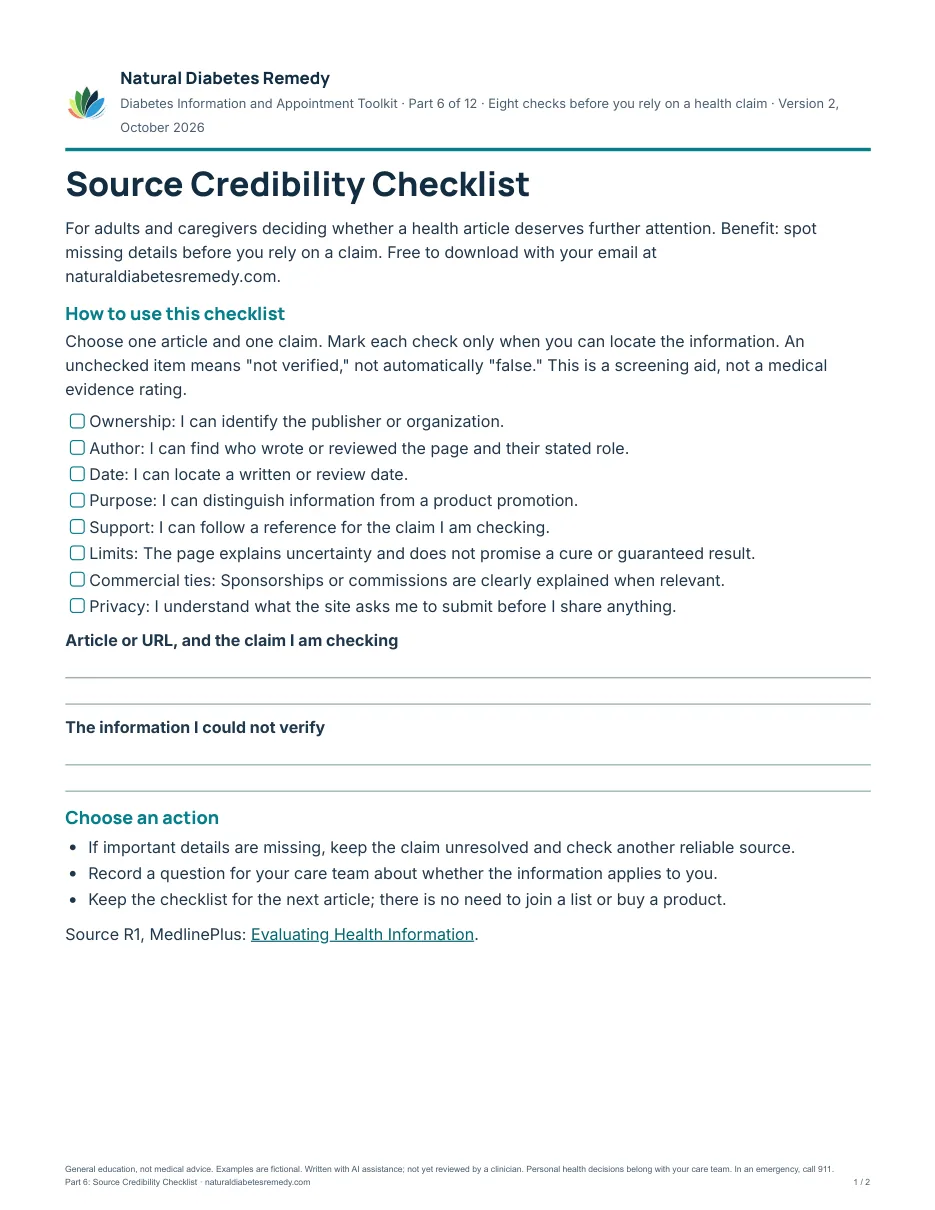
Checking a provider’s claims works the same way as checking any health page. Our one-claim check walks through a single claim in a few minutes, and the free Source Credibility Checklist adds eight checks on two printable pages. The checklist opens straight away as a PDF, with no form to fill in.
Questions readers ask.
Can I ask these questions before I pay for a consultation?
Yes, and it is reasonable to ask. You can ask before you book. Some practices answer a short question by email or in a brief call, and it is fine to ask the office which they prefer. If a provider will not answer three short questions, that tells you something about how the first visit may go.
How can I tell a supplement scam from a careful provider?
Look at the language and the proof. Careful providers describe limits, name sources and do not promise to end a condition. Scam patterns include claims that a product can replace prescribed medicine, testimonials used as proof, pressure to buy today and no named ingredients.
Are there FDA approved diabetes supplements?
Treat the phrase ‘FDA approved’ on a supplement page as a claim to check, not a reassurance. Ask the seller for the exact wording in writing, and ask your pharmacist what the label claim means. The FDA page on illegally sold diabetes treatments describes the products the agency warns about.
Will a holistic provider tell me to stop my medicine?
Some might. You do not have to agree, and you can say no. Prescribed medicine is your prescriber’s decision, so bring the suggestion to your prescriber or pharmacist before you change anything.
Does this page tell me to avoid holistic providers?
No. It gives you three filtering questions so that you can decide with better information. What you do with the answers is a decision for you and your care team.
General education only. This page helps you organize learning and questions. It is not medical advice and does not recommend a treatment, diet, medicine or blood-sugar target. Personal health decisions belong with your care team. Medical and educational disclaimer
Sources and editorial notes
- National Center for Complementary and Integrative Health, Diabetes and Dietary Supplements: What You Need To Know, retrieved October 18, 2026.
- MedlinePlus, National Library of Medicine, Diabetes, retrieved October 18, 2026.
- US Food and Drug Administration, Illegally Sold Diabetes Treatments, retrieved October 18, 2026.
- Question and note formats are adapted from our free Care-Team Conversation Planner and exercise 5 of the Seven-Day Everyday Learning Workbook.
Examples are illustrative. Not yet reviewed by a clinician. See our Editorial Policy, Review Methodology and Affiliate Disclosure.
Keep checking before you commit.
Source Credibility Checklist
Check who wrote a claim and what supports it. Free online or as a PDF.
Before You Trust a Health Article, Check One Claim
Publisher, author, date, support and commercial ties.
Prepare Three Questions for Your Care Team
Prioritize questions and record a next step.
Ask better questions before you book.
The free workbook adds practice in checking a health information source and preparing care-team questions.
Immediate access after your request, then 4 short emails. Every email has an unsubscribe link.