
Getting started
Where to start with prediabetes this week: read a label, check a source, prepare three questions.
Choose one door, finish one ten-minute task and know when it is done. You do not have to read everything at once.
Free to read. No sign-up for this page.
One search leads to fifty tabs. One site says count every gram of carbohydrate. Another says grams are not the point. A third promises a simple answer, and a fourth warns you away from the first three. So you close the laptop, make the same plain meal you made yesterday and eat it without really deciding anything.
That is a starting problem, not a knowledge problem. This page gives you three doors: read one food label, check one health claim, or write three questions for your care team. Each door has a ten-minute task and a done-check: one sentence you can say when the task is finished. Pick one. You are allowed to close the other two.
Education only. This page does not tell you what to eat, which supplement to try or what your numbers should be. Those decisions belong with your care team.
Two plain definitions first. Diabetes is a disease in which blood glucose, or blood sugar, levels are too high. Prediabetes means blood sugar levels that are higher than normal but not high enough for a diagnosis of type 2 diabetes. Almost everything else depends on you, your history and your care team.
Pick one door, then stop.
Most of what helps in the first weeks fits into three skills. Which one is nagging at you right now?
Door one: a label
Find the serving line, then the servings per container. Do the arithmetic on one package.
Door two: a source
Run one health claim through eight short checks and note what stays unclear.
Door three: questions
Write three questions for your next visit, with a place to put the answers.
Only have five minutes? Do the first step of any door. The first step is always the smallest one.

Door one: how to read a food label.
Start with a package already in your kitchen. A label can show two different amounts for the same food, and the difference is usually the serving line. Reading it is arithmetic. It is not a verdict on whether a food is good or bad, and nothing here chooses a food for you.
Find the serving size.
This line says what amount the numbers underneath it describe.
Find the servings per container.
This line says how many of those amounts the package holds.
Multiply when a package holds more than one.
Two servings means twice the numbers in the panel. That is the whole method.
Here it is on a fictional practice label that mirrors the one in the free workbook.
| Food | Invented vegetable soup, fictional label |
|---|---|
| Serving size | 1 cup |
| Servings per container | 2 |
| Carbohydrate | 18 g per serving |
18 g per serving × 2 servings = 36 g for the whole container
Illustrative numbers on a fictional label. Not a recommended serving, food choice or target.
Try a three-question food label quiz.
Cover the right-hand column and try it with the practice label above.
| Quiz question | Answer from the fictional label |
|---|---|
| How much of the package counts as one serving? | 1 cup, from the serving size line. |
| How many servings are in the container? | Two, from the servings per container line. |
| The panel lists 18 g of carbohydrate per serving. What does the container hold in total? | 36 g: 18 g multiplied by 2 servings. |
Practice arithmetic only. Nothing here says what to eat or how much.
“Net carbs” is not on the panel.
You will see “net carbs” on packages and in blog posts, and it is not a term you find on the Nutrition Facts panel. It is usually a subtraction someone has already done for you, and different sources subtract different things. That is why the arithmetic on the panel is the part you can check yourself. Our article Net Carbs Is Not a Label Term explains what the phrase does and does not tell you.
Done-check: you can point at any number on that label and say whether it describes one serving or the whole package, and you know “net carbs” is not a line printed there.
For the longer version, Food-Label Numbers Start With the Units walks through the same method with a second example.
Door two: check one source before you trust it.
Pick one claim you saw this week: a video, an email, a message forwarded by a relative. Not the whole page, just the claim. Then answer eight questions.
- Ownership. Who runs the site, and is that easy to find?
- Author. Is a person named, with a reason to know the subject?
- Date. When was it published or updated?
- Purpose. Is it informing, selling, or both?
- Support. Does it point to original research or a public agency?
- Limits. Does it say what is not known?
- Commercial ties. Is something being sold next to the claim?
- Privacy. Does it ask for information before it gives any?
Those eight checks are the whole of our Source Credibility Checklist, a two-page PDF that opens with no email address.
Done-check: you can name the owner, the date, and one thing the page does not tell you.
Slow down when the claim sells a supplement.
Look for three things at once: a big promise, a vague source and a purchase button at the end. Then check what the public agencies say.
The National Center for Complementary and Integrative Health (NCCIH) looked at what is known about dietary supplements for diabetes. For a few there is weak evidence of a possible benefit. For most there is not evidence to support a beneficial effect on diabetes or its complications, and some supplements have side effects that can be serious, such as kidney damage. NCCIH also reports that the FDA warns about diabetes products that seem too good to be true and are marketed illegally, and that some are harmful in themselves. NCCIH’s advice is direct: do not replace medical treatment for diabetes with an unproven product or practice.
None of that makes every supplement dangerous. It means the evidence is thin, the selling is often loud, and the decision belongs in a conversation with your care team rather than on a checkout page.
Door three: questions to ask about prediabetes.
An appointment is short. Three questions written down before you go do more than thirty you meant to ask. One index card is enough.
Say what you want to understand.
One sentence in your own words.
Write two questions.
Ask about the thing you keep thinking about between visits.
Leave a line for the answer.
Note who will do what next, and when you will follow up.
- Can we go over my last result together and tell me what it means for me?
- Is there anything about my medicines I should watch for?
- What would you like me to focus on before we speak again?
Invented questions for practice. Bring your own; these are not a script or a standard of care.
Done-check: three questions written where you will see them on the day, with room under each one for an answer.
The Care-Team Conversation Planner is a free two-page PDF that holds the date, the questions, the agreed next step and the follow-up. It opens with no email address.

Put an A1C result in the right conversation.
A1C comes up in almost every diabetes search, usually attached to a promise. Plainly, an A1C result is one piece of information, and what it means depends on your history, your other results and why the test was ordered. This site will not interpret your number, and you should be wary of any site that offers to without knowing you.
If you have a result in front of you, the next useful step is a question, not another tab: “Can we go over this result and what it means for me?” That is Door three.
Keep results out of emails and forms, including ours. We do not ask for health details and would rather you did not send them.
Keep each task to ten minutes.
You may be thinking this sounds like homework, and that you are already tired of health homework. That is a fair objection. It is also why every task above has a stop line.
- Ten minutes, then stop, even mid-sentence. An unfinished task still counts as done for the day.
- One door per week. Three doors in one evening is how the fifty tabs happened.
- A missed day is information for adjusting the plan. Shrink the task instead of quitting it.
What this site is, and what it is not.
You may have arrived looking for treatment options and found a page about labels and sources. That is a real mismatch, so here is the honest version.
- We publish education, not instructions. We do not tell you what to eat, which supplement to buy or what your numbers should be.
- This page has not been reviewed by a clinician yet, and the note at the top of the page says so rather than hiding it in a footer.
- Our buying guides name no products yet, and no affiliate links are active today. If that changes, the Affiliate Disclosure and Privacy Policy change first.
- Two free tools open with no email at all: the Source Credibility Checklist and the Care-Team Conversation Planner.
- The workbook is the one free download that asks for a first name and email. Signing up is the opt-in, there is no checkbox to hunt for, and every email carries an unsubscribe link. We also send four short follow-up emails over about ten days.
- We do not ask for health details, here or anywhere.
If you want the rules in full, read the Editorial Policy.
Answer a few first questions.
Where should I start if I feel behind on learning about prediabetes?
Pick one door and give it ten minutes: read one label, check one claim or write three questions. One finished task beats fifty open tabs, and you can choose a different door next week.
Is there a food label quiz I can use for practice?
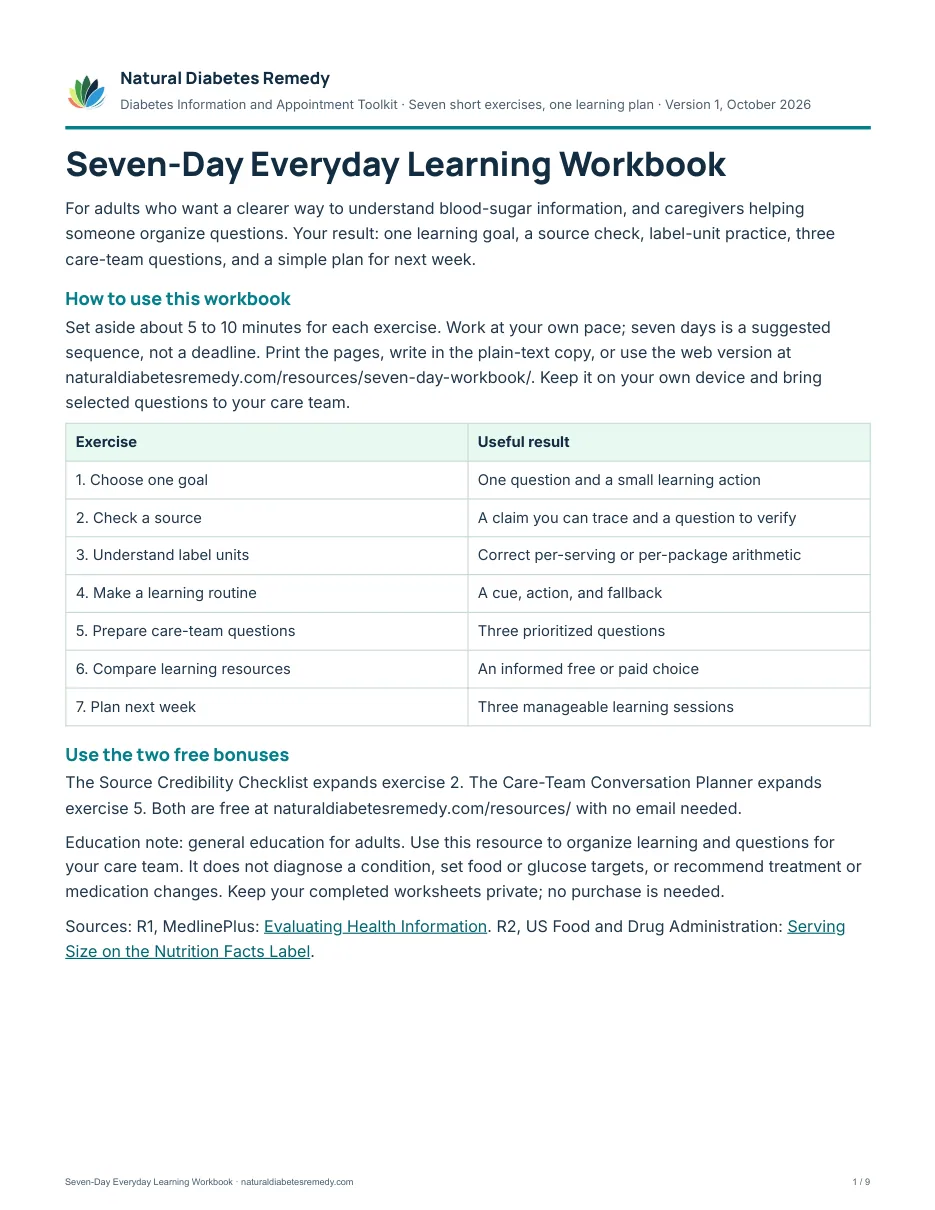
Yes. Door one has a three-question quiz on a fictional practice label, with the answers in the next column. Exercise 3 of the free Seven-Day Everyday Learning Workbook repeats the same arithmetic on paper.
How can I spot supplement scams?
Look at who owns the page, what supports the claim and what is being sold beside it. NCCIH reports that for most supplements there is not evidence to support a beneficial effect on diabetes or its complications, and that the FDA warns about diabetes products marketed illegally. Talk with your care team before trying any supplement.
What questions should I ask my doctor about prediabetes?
Three: what you want to understand, what you want to ask, and what the agreed next step is. Leave space under each one for the answer.
What does an A1C result mean?
This site does not interpret results. An A1C result belongs in a conversation with your care team, who can explain it alongside your history and your other information.
General education only. This page helps you organize learning and questions. It is not medical advice and does not recommend a treatment, diet, medicine or blood-sugar target. Personal health decisions belong with your care team. Medical and educational disclaimer
Sources and editorial notes
- National Center for Complementary and Integrative Health (NCCIH), Diabetes and Dietary Supplements: What You Need To Know, retrieved October 18, 2026.
- US Food and Drug Administration, Illegally Sold Diabetes Treatments, retrieved October 18, 2026.
- US Food and Drug Administration, Serving Size on the Nutrition Facts Label, retrieved October 18, 2026.
- MedlinePlus, National Library of Medicine, Diabetes, retrieved October 18, 2026.
- The label arithmetic and the three-question structure follow exercises 3 and 5 of our free Seven-Day Everyday Learning Workbook; the quiz questions on this page are our own practice.
Examples are illustrative. Not yet reviewed by a clinician. See our Editorial Policy, Review Methodology and Affiliate Disclosure.
Pick the next small step.
Food-Label Numbers Start With the Units
Weight, volume and serving information on a label.
Before You Trust a Health Article, Check One Claim
Publisher, author, date, support and commercial ties.
Prepare Three Questions for Your Care Team
Prioritize questions and record a next step.
One goal is enough for this week.
The free Seven-Day Everyday Learning Workbook turns one goal into a short exercise you can finish and review.
Immediate access after your request, then 4 short emails. Every email has an unsubscribe link.