
Getting started
Five-minute diabetes learning tasks for your evening.
Ten small evening tasks, sized to the time dinner takes. Each one has a done check and a lower-energy fallback for the days you are worn out.
You have been on your feet since the office opened. By the time you get dinner going, a diabetes education program sounds like a second job: another login, another workbook, another thing you are behind on. So it waits, and a quieter worry sits underneath. What if I ignore this until it turns into something bigger?
This page offers something smaller: ten tasks of about five minutes each, sized to the time it takes to get a pan on the stove. Every task has a done check, so you know when to stop, and a zero-energy fallback for the evenings that have already used you up.
This is education, not a treatment plan. These tasks help you read a label line, check a claim and write down a question. They do not tell you what to eat, which product to take, or what any number means for you; those conversations belong with your care team. If it still sounds like homework, do one task and skip the rest.
Five minutes is enough to stop feeling lost.
The aim is not to memorize nutrition science. It is to know where to look, and to have looked once. A label line you have read before is easier to read again, and a claim you have checked once is easier to recognize the next time it shows up in a video or on a bottle.
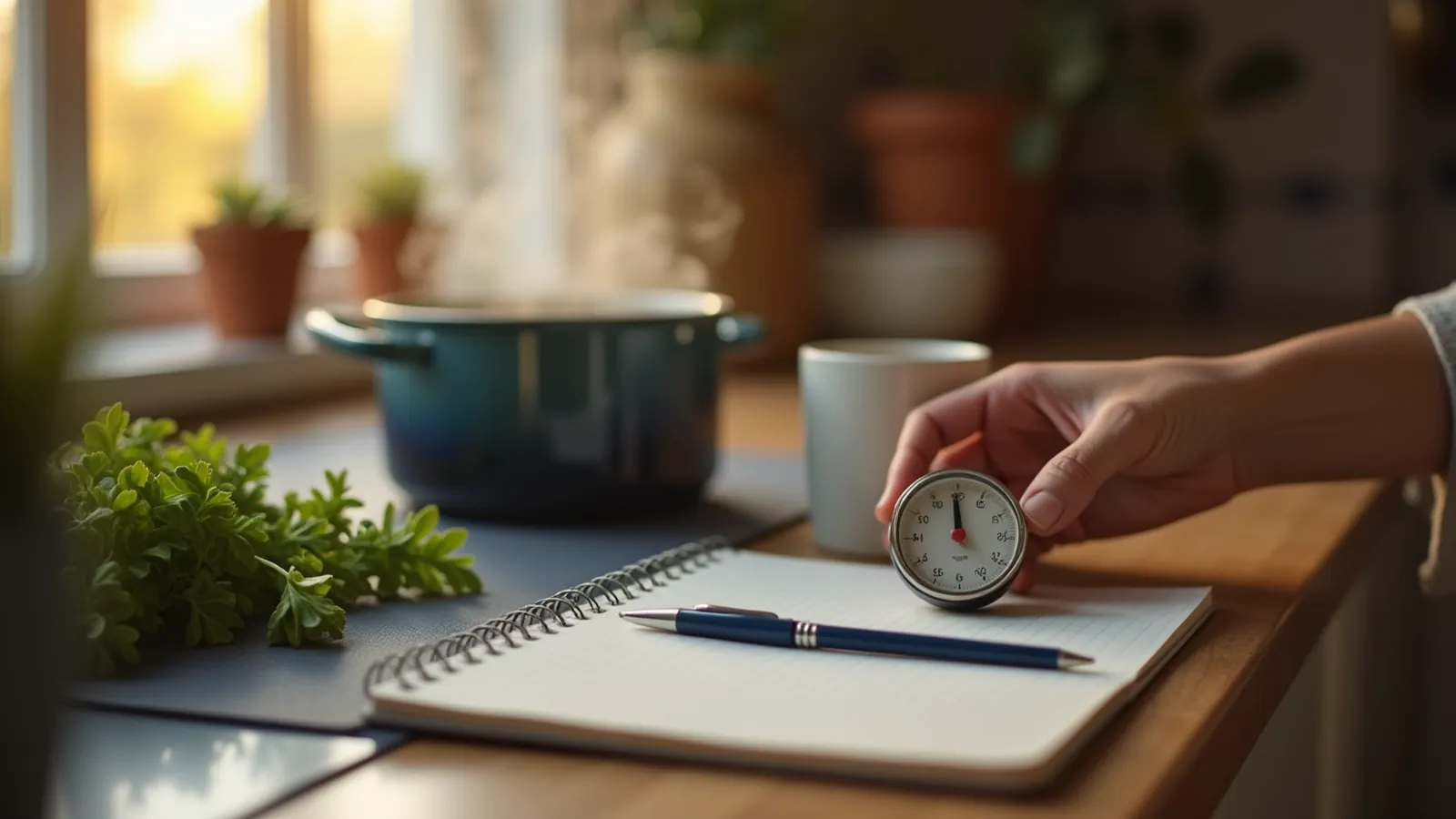
Dinner gives you a natural slot. You are already standing in one place, waiting for water to boil or onions to soften. That waiting time is the whole session. No account, no program to finish, no streak to keep.
One rule keeps it small: pick a task, pass the done check, stop. Doing one task counts as finishing.
If you would rather read than practice, MedlinePlus keeps a Diabetes health topic page that collects public resources, including material on your diabetes care team.

Ten tasks you can do while dinner cooks.
Each task has three parts: what you do, how you know you are done, and what to do on a zero-energy day. The fallback keeps the thread going. It is not a failure.
| Task | Done check | Zero-energy fallback |
|---|---|---|
| 1. Read the serving size line | You can say the serving size in your own words | Read the number and the unit, then stop |
| 2. Find the servings-per-container number | You know whether the package holds one serving or more | Point at the line and leave it |
| 3. Read one nutrient line and its unit | You can name the unit, such as grams | Cover the rest of the label and read one line |
| 4. Compare the same line on two similar packages | You noticed whether the numbers differ | Read one package only |
| 5. Find who is responsible for a claim | You found a company or author, or noted that you could not | Photograph the label and move on |
| 6. Look for a promise to replace your diabetes medicine | You answered yes or no for that one product | Put the bottle or printout in a folder marked later |
| 7. Check the date on a health page you have open | You found a date, or noted that none is shown | Bookmark the page |
| 8. Scan the headings on the FDA page about illegally sold diabetes treatments | You know where to look up a product another time | Open the page and read the title only |
| 9. Write one question for your care team | One sentence is on paper | Say the question out loud once |
| 10. Put that question where you will see it before the appointment | It is in your calendar, notebook or bag | Leave the paper on the kitchen table |
A list to pick from, not a plan to complete. Repeat one task for a week or stop after the first. Nothing here recommends a food, a portion or a product.
One evening, minute by minute.
Here is what a single task looks like when the evening is already full.
6:08 p.m. Water on to boil. Read the serving size line. Say it once. Write it on the envelope by the stove. Stop.
An invented evening for practice. It does not set a schedule, a portion or a food choice for anyone.
That is the whole session. With two minutes to spare, the second task is to compare the same line on a second package and notice whether the numbers differ. With nothing left, use the fallback: read the number and the unit, skip the writing.
Exercise 3 of the free Seven-Day Everyday Learning Workbook adds a fictional label so you can practice the arithmetic without a real product. It shows a 1-cup serving, 2 servings in the package, and 18 grams of carbohydrate per serving.
18 g per labeled serving × 2 servings in the package = 36 g for the package
Illustrative numbers on a made-up label. Not a recommended serving, food choice or target.
Reading units before doing the math is the whole idea behind our food label quiz. If a number surprises you, write it down as a question for your care team rather than a conclusion about your own eating. The FDA also publishes a page on serving size on the Nutrition Facts label if you want the official explanation of that line.
Check one claim before you spend money.
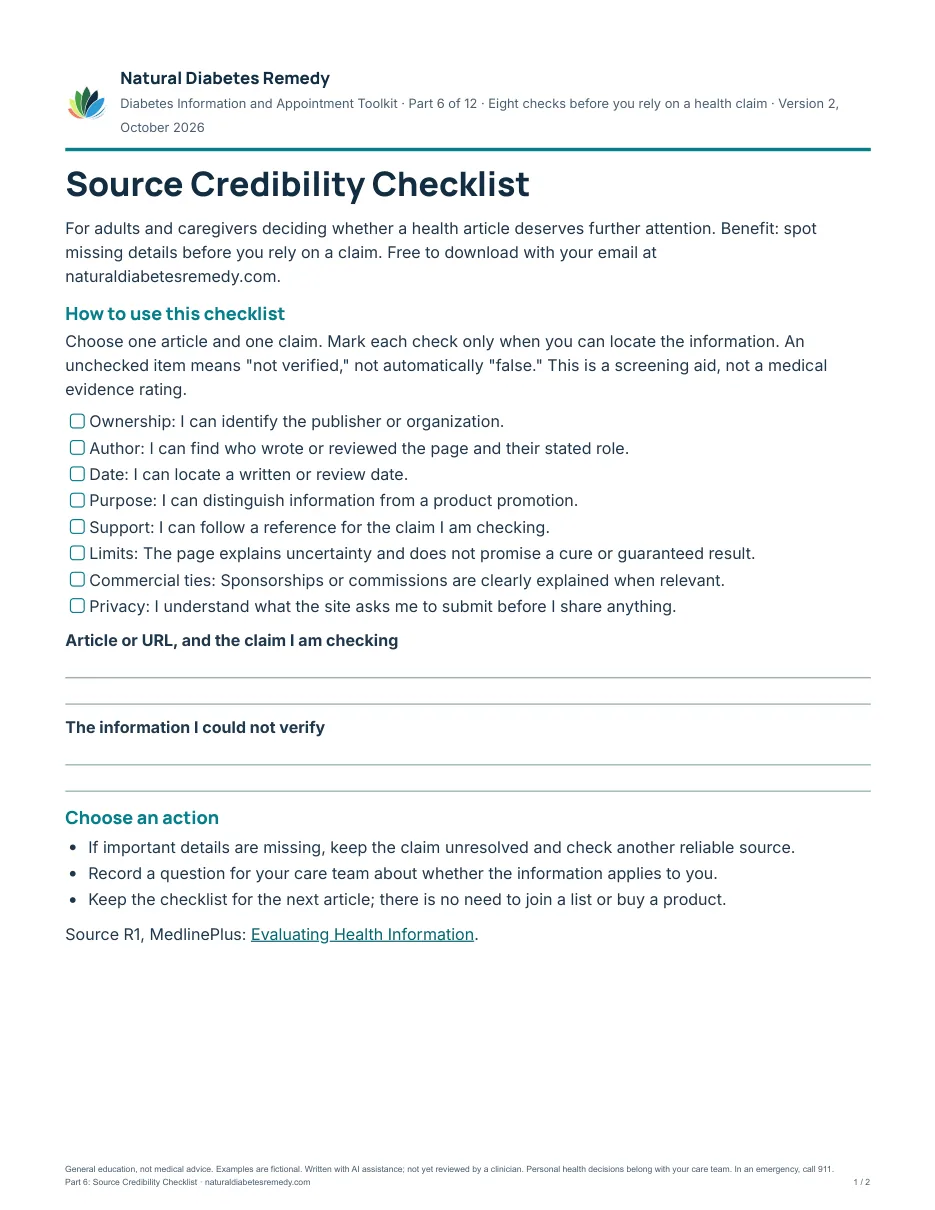
Evening is when claims find you: a video, a bottle in the cupboard, a message from a friend. A five-minute claim check is four questions.
- Who is responsible for the claim? A named company, clinic or author, or nobody?
- What supports it? A source you can open, or a story?
- When was it written? A date you can find, or none?
- What do they want from you? A purchase, a sign-up, or nothing?
If you cannot answer the first question, that is your answer for tonight. Note the product name and move on.
For products sold as blood sugar support, the public record is worth knowing. The National Center for Complementary and Integrative Health (NCCIH) reports that for a few dietary supplements there is weak evidence of a possible benefit, that most supplements do not have evidence supporting a benefit for diabetes, and that some can have serious side effects, including kidney damage. NCCIH also notes that the FDA warns about diabetes products that seem too good to be true, such as products that claim to replace your diabetes medicine; those products are marketed illegally. NCCIH’s advice is not to replace medical treatment with an unproven product or practice.
That is why this page hands you a checklist instead of a bottle. Our article on supplement scams walks through the same four questions in more detail, and the free Source Credibility Checklist puts them on two printable pages, with a worked example and a review note. MedlinePlus also has a short guide to evaluating health information. The checklist downloads without an email address.
Write the question while it is fresh.
Reading raises questions, and most of them vanish before the appointment. That makes the third kind of task the most useful one: write a single question in one sentence and put it where you will see it again.
- What do I want to understand?
- Which one change am I most unsure about?
- What did I read that I could not check?
My question for my care team: one sentence
Keep it to one question per evening. Our guide to preparing three questions for your care team shows how to sort them and what to do with the answers.
Please do not send health details to us. We do not ask for them, and we cannot advise on your medicines, results or symptoms.
Review once a week in two minutes.
At the end of the week, look at whatever you wrote and ask three questions.
- Which task did I actually do?
- Which fallback did I use?
- What is still unclear?
Then change one thing at most: move the task to a different moment in the evening, shrink it, or repeat the same one next week. A skipped evening is information for adjusting the plan. It says nothing about your health or your character.
For a week of short reads instead of tasks, see our five-minute learning routine. Exercise 7 of the workbook helps you plan three sessions when you are ready.
What this page does not do.
You may have arrived looking for treatment options, including ones described as natural or holistic. This site does not sell a supplement, a treatment plan or a promised result, and it does not tell you what to eat or which product to take. It teaches checking: labels, claims and sources. Deciding what to do with what you learn belongs with your care team.
You may also have been burned by free health information that turned into a sales pitch. Here is what is true today. No products are named on this page, no affiliate links are active on the site, and the checklist and planner download without an email address. The workbook asks for a first name and email because it is delivered by email, and every email includes an unsubscribe link. If that ever changes, the Affiliate Disclosure and Privacy Policy change first.
Nobody has clinically reviewed this page. It is written by the Natural Diabetes Remedy editorial team, and our Editorial Policy explains how pages are written and corrected.
Common questions.
What counts as a five-minute diabetes learning task?
Any single, small step you can finish in about five minutes: reading one label line, checking one claim, or writing one question for your care team. Each task on this page has a done check and a lower-energy fallback.
Is there a food label quiz I can try without buying anything?
Yes. Our food label quiz page uses fictional labels, and exercise 3 of the free Seven-Day Everyday Learning Workbook includes a made-up label with 1-cup servings, 2 servings per container and 18 grams of carbohydrate per serving.
How can I tell whether a blood sugar supplement is a scam?
Start with four questions: who is responsible for the claim, what supports it, when was it written, and what do they want from you. NCCIH reports weak evidence for a few supplements and no supporting evidence for most, plus serious side effects for some, and the FDA warns about diabetes products marketed illegally.
Which doctor visit questions should I write down first?
Write the question you most want answered in one sentence, then add what you read that you could not check. Keep it where you will see it before the appointment, and bring the answers home in writing.
Do I need to give my email address to use these tasks?
No. The ten tasks are on this page, and the Source Credibility Checklist and Care-Team Conversation Planner download without an email address. The workbook asks for a first name and email because it is sent by email.
General education only. This page helps you organize learning and questions. It is not medical advice and does not recommend a treatment, diet, medicine or blood-sugar target. Personal health decisions belong with your care team. Medical and educational disclaimer
Sources and editorial notes
- National Center for Complementary and Integrative Health (NCCIH), Diabetes and Dietary Supplements: What You Need To Know, retrieved October 18, 2026.
- US Food and Drug Administration, Illegally Sold Diabetes Treatments, retrieved October 18, 2026.
- US Food and Drug Administration, Serving Size on the Nutrition Facts Label, retrieved October 18, 2026.
- MedlinePlus, National Library of Medicine, Diabetes, retrieved October 18, 2026.
- MedlinePlus, National Library of Medicine, Evaluating Health Information, retrieved October 18, 2026.
- The done check and fallback pattern is adapted from exercises 3, 4 and 7 of our free Seven-Day Everyday Learning Workbook.
Examples are illustrative. Not yet reviewed by a clinician. See our Editorial Policy, Review Methodology and Affiliate Disclosure.
Keep it small, keep it going.
Learn About Prediabetes in Five Minutes a Day
Seven short reads, a cue and a fallback.
Source Credibility Checklist
Check who wrote a claim and what supports it. Free online or as a PDF.
Supplement Scams: Before You Buy Blood Sugar Support
Run a simple eight-point check on any pill ad before you pay.
One small task tonight, not a whole program.
The free workbook collects seven short learning exercises, including a fictional label to practice on and space for three care-team questions.
Immediate access after your request, then 4 short emails. Every email has an unsubscribe link.