
Choosing resources
Report a false supplement claim before the ad vanishes.
Save the ad, copy the exact words, file it in one place, and keep one page for your care team. A few minutes a step, and nothing to buy.
Education only. No supplement, product or treatment is recommended here.
You had the bottle in the cart. The ad said the capsules would do the work of your prescription, the reviews sounded like neighbors, and the price dropped if you ordered in the next ten minutes. You closed the tab. Later you read, on a government page, that products sold that way are marketed illegally, and a smaller, worse feeling arrived: what else have I almost believed?
That embarrassment is aimed at the wrong person. Nobody hands you a method for checking a supplement ad. You were not careless; you were unarmed.
So here is the method, plus the step most pages skip: what to do with the ad once you catch it.
Practice with the free toolkit.
The free Diabetes Information and Appointment Toolkit has twelve parts in one printable book: a start-here guide, the test words you will hear, questions about your results, programs to ask about, label practice, a question builder, a source check, a caregiver pack, a 30-day planner, a glossary, a seven-exercise workbook and a household week planner.
Free, no payment card. Reply VERIFY to our short email and we'll send you the toolkit, then 5 short emails over 12 days (one names our own $9 Fillable Edition), then at most one email a week, when we publish a new guide. Every email has an unsubscribe link.
The short version.
Three steps, a few minutes each, at the kitchen table. You can stop after any of them.
Save the page as it looks today.
A full screenshot, top to bottom, and the address in the bar. A page can change by tonight; a screenshot cannot.
Copy the claim word for word.
Not your summary. The sentence itself, and the product name exactly as printed.
File it and keep the record.
Advertising goes to the Federal Trade Commission. The product and its label go to the FDA. Keep the confirmation with your note.
You do not have to buy anything to report it. Every step here works on an ad you never ordered from.
Save the ad before it disappears.
An ad can vanish. The seller can edit the page, swap the photo or pull the offer, and the thing that worried you no longer exists to show anyone.
| What to save | Where to find it |
|---|---|
| The page address | The whole link from the bar, not just the shop name. |
| The date and time | Your phone’s clock is enough. Write it beside the screenshot. |
| A full screenshot | The promise, the price, the timer and the fine print. |
| The product name | Exactly as printed, plus the size or count. |
| Who is selling | Company name, contact address, a phone number if there is one. |
| Where you saw it | A social post, an email, a search ad, a magazine page. |
A record for your own file. Nothing here asks you to buy anything.
On a phone, screenshot the top and the bottom. The bottom usually holds the fine print, the refund terms and the company name.
Copy the exact claim, not your summary.
“It said it would fix my numbers” is your reading of the page. An agency can only check the words as they appear, so copy the sentence exactly, odd capitalization included, and put it in quotation marks. Copy the sale promise too: the free bottle, the cancel-anytime line, the refund terms. Those words, plus the date you saw them, do most of the work.
Detect false claims on health products.
You do not need a science background. These are habits of advertising, not proof about any one product.
- A promise to take the place of a prescribed medicine.
- One bottle offered for several unrelated problems.
- Stories and before-and-after photos where a source should be.
- No company name, no address, no way to reply.
- A countdown, a limited batch, or a price that ends tonight.
- An instruction to stop your medicine so the product can work.
Any one of these is a reason to pause. Missing information is not the same as a lie. It means you cannot check the page yet, and that is exactly the situation a report is for.
Look for the disclaimer line.
US supplement labels can carry several kinds of claims, including structure or function claims about how a product affects the body. When a label carries one, the FDA says it must also carry a statement that the claim has not been evaluated by the FDA and that the product is not intended to diagnose, treat or prevent a disease. A page full of health promises with no such line anywhere is worth writing down.
Examples of the pattern.
These are invented shapes of ads, not quotes from a real one.
- A capsule described as a stand-in for a prescription, sold with a timer.
- A powder that lists five unrelated problems on one label.
- A fitness product whose whole case rests on one customer story and no source.
False advertising claims about health and fitness products follow the same shapes, whether the thing for sale is a drink, a device or a subscription.
Run the same check on a package.
The ad check asks who is behind the words. A food label asks something similar, in numbers you can read in a minute. Start with the serving size line before any other number, because the rest of the panel is tied to it. If a page starts talking about net carbs, slow down and ask who is subtracting what: net carbs is not a term on a US Nutrition Facts label. The net carbs explainer shows what the label does and does not say.
File it in one of two places.
Two federal routes cover most of this, and the split is simple.
The FTC: the advertisement
The Federal Trade Commission takes complaints about advertising through the complaint route on ftc.gov. Use it for the words of the ad: the promise, the timer, the free bottle that was not free.
The FDA: the product and its label
The FDA oversees how dietary supplements are labeled and what claims may appear. Its consumer information points readers to the FTC for advertising. The consumer complaint route is on fda.gov.
Open your screenshot and the copied claim.
Have both in front of you before you start the form.
Paste the address and the date.
The page link, and the day you saw the ad.
Paste the exact words, then keep the confirmation.
Put the sentence in quotation marks and name the product and the seller. Leave your own health details out of the report.
A short report that lands in the wrong office is better than a careful one you never send. If you are unsure which fits, file with both.
Keep one page for your care team.
The record is for you. The questions are for your next appointment, and three is enough.
| Product as printed | the name on the bottle, plus the size |
|---|---|
| The exact claim | the sentence, in quotation marks |
| Where and when I saw it | the site or app, and the date |
| Filed with | FTC, FDA, or both, and the date sent |
| Confirmation kept | reference number or screenshot |
| Question one | what I want to understand, in one line |
| Question two | one question, written as a question |
| Question three | one question, written as a question |
Your own record, not a rating of the product. A blank line is a step still to do.
The Care-Team Conversation Planner has space for the same three questions and for the answers you get back.
See what a filled page looks like.
This example is invented. The product, the seller and the ad are made up for practice.
One ad, kept and reported
Product as printed: “Steady Day Capsules” (a made-up name)
The exact claim: “One capsule a day and you never have to think about your numbers again.”
Where and when: a sponsored post in my feed, Tuesday evening
Saved as: two screenshots, top and bottom, with the price and timer visible
Filed with: the FTC complaint route for the ad, the FDA consumer complaint for the label
Question one: “Is there anything on a label like this I should be careful about with what I already take?”
Made up for practice. No real product, seller, agency, person or result is described.
Notice what the page does not contain: a verdict about the product, or a medical opinion. It is a record, and the questions belong to your care team.
Why a site like this asks you to check it, too.
This site is education, not a clinic. It helps you check a source, read a food label and prepare questions for your care team. The name includes the word remedy; the content does not promise one. Nobody has clinically reviewed this page yet, and our Editorial Policy describes how pages are written.
NCCIH, part of the National Institutes of Health, puts two points plainly: for most supplements there is no evidence to support a benefit for diabetes or its complications, and some supplements may have side effects, a few of them serious, including kidney damage. It adds that it is very important not to replace medical treatment for diabetes with an unproven health product or practice.
The FDA describes the pattern you almost met: products for diabetes that seem too good to be true, marketed illegally, some harmful in themselves and all harmful if used in place of effective treatment. None of that says every product on a shelf is dangerous. It says the decision belongs with someone who knows your medicines, not with a page that has a timer on it.
On the sales-pitch worry: the checklist works in your browser, and nothing here asks for your results, your medicines or your diagnosis. This site does not sell supplements. Our $9 fillable workbook set is the only paid product, and the free tools are complete without it. Point the same suspicion you use on other pages at this one first.
Close the tab with a copy in your hand.
You do not need to decide anything about the product today. You need the record, three questions, and a way to check the next ad in five minutes. The supplement scam guide and how to check a natural remedy claim run the same checks on other kinds of pages.
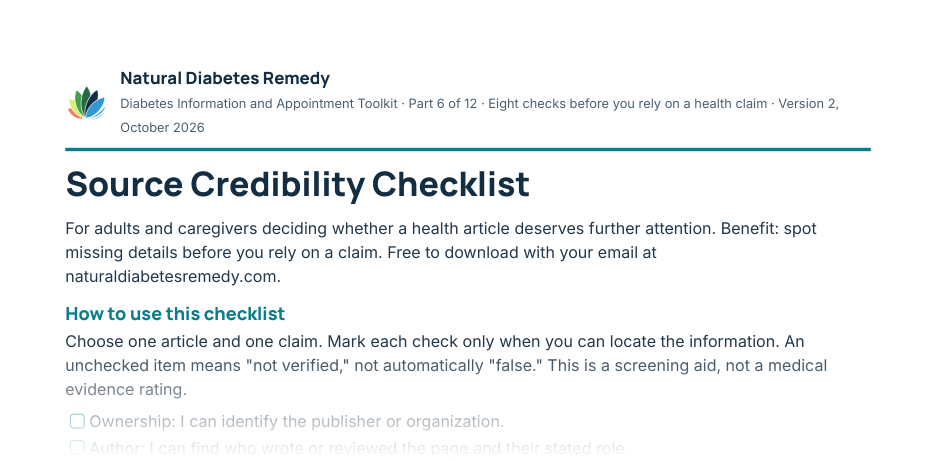
Source Credibility Checklist
Eight checks for one page, a choose-an-action step, a worked example and a review note you can reuse.
Works in the browser. The two-page PDF comes by email after you reply VERIFY.
Quick answers.
Where do I report a false supplement claim?
Advertising goes to the Federal Trade Commission through the complaint route on ftc.gov. The product and its label go to the FDA on fda.gov. Keep the confirmation with your note.
How do I report false advertising if I never bought the product?
You do not have to buy anything. Save the page address, a full screenshot with the date, the exact claim in quotation marks and the product name as printed, then file.
What are examples of false health claims in advertisements?
A promise to take the place of a prescribed medicine, one bottle offered for unrelated problems, stories where a source should be, a price that ends tonight. Any one is a reason to pause, not proof.
How do I detect false claims on health products without training?
Read the promise, not the story. Ask who wrote the page, who paid and what it points to. On a supplement label, look for the statement that the claim has not been evaluated by the FDA.
General education only. This page helps you organize learning and questions. It is not medical advice and does not recommend a treatment, diet, medicine or blood-sugar target. Personal health decisions belong with your care team. Medical and educational disclaimer
Sources and editorial notes
- US Food and Drug Administration, Dietary Supplements: What You Need to Know, retrieved October 18, 2026.
- National Center for Complementary and Integrative Health, Diabetes and Dietary Supplements: What You Need To Know, retrieved October 18, 2026.
- US Food and Drug Administration, Illegally Sold Diabetes Treatments, retrieved October 18, 2026.
Examples are illustrative. Not yet reviewed by a clinician. See our Editorial Policy, Review Methodology and Affiliate Disclosure.
Keep the record. Skip the verdict.
One screenshot, one quoted sentence, one page for your care team.
Source Credibility Checklist
Check who wrote a claim and what supports it. Free online or as a PDF.
Supplement Scams: Before You Buy Blood Sugar Support
Run a simple eight-point check on any pill ad before you pay.
How to Check Natural Remedy Claims Safely
A side-by-side table of what NCCIH and FDA each can tell you.
Start with one useful question.
Get the free Diabetes Information and Appointment Toolkit. No purchase required.
Free: reply VERIFY to our short email and we send it to you, then 5 short emails, then at most one email a week, when we publish a new guide. Every email has an unsubscribe link.