
Getting started
Your doctor said eat better and exercise. Now what?
A five-line card to fill in before bed, a two-minute rule for the search tabs, and one evening walked through step by step.
You heard it on the way out of a short appointment, maybe while you were already standing up: eat better and exercise. Then you drove to the dental office, closed out the schedule, answered one last insurance question, and got home after a day that belonged to everyone else.
By nine o'clock the tabs are open. One page says food matters most. Another says movement does. A third is selling a bottle. You have read a lot and you still cannot name one thing you will do tonight.
This page offers three small things: a five-line card to fill in before bed, a two-minute rule for the search tabs, and one evening walked through step by step.
This is education, not a treatment plan. Nothing here tells you what to eat, how much to move, which product to take, or what any number means for you. It teaches three skills: reading a label line, checking a claim and writing a question for your care team. The decisions stay with them.
Practice with the free toolkit.
The free Diabetes Information and Appointment Toolkit has twelve parts in one printable book: a start-here guide, the test words you will hear, questions about your results, programs to ask about, label practice, a question builder, a source check, a caregiver pack, a 30-day planner, a glossary, a seven-exercise workbook and a household week planner.
Free, no payment card. Reply VERIFY to our short email and we'll send you the toolkit, then 5 short emails over 12 days (one names our own $9 Fillable Edition), then at most one email a week, when we publish a new guide. Every email has an unsubscribe link.
Vague advice is hard to act on. That is not laziness.
“Eat better and exercise” names two categories, not an action. An action has a verb and a finish line. “Read the serving size line on one package tonight” finishes; “eat better” never does. That is how two sentences at the end of an appointment become one more thing you feel behind on.
Turning those categories into a plan for your body takes your health history, the medicines you take and the shape of your week. That is a care-team conversation. What you can practice in five minutes is the part already in front of you: the label, the claim, the search result, the question.

Write five lines before bed.
Five lines, one action, one check-off. Copy them onto the back of an envelope or a sticky note.
Line 1: my one action.
Read one label line, or check one claim. Not both.
Line 2: when I start.
A moment you can keep, such as while the kettle heats.
Line 3: what I noticed.
One sentence. “Two servings in the package, not one.”
Line 4: my question.
One sentence for your care team, or leave it empty.
Line 5: the box.
Tick it when the timer ends, then stop, even if you are curious.
Your card · fill it in
1. My one action: read one label line or check one claim
2. I start at: a time you can keep
3. What I noticed: one sentence
4. My question for my care team: one sentence, or leave empty
5. Done: check here when the timer ends
Exercise 3 of the free Seven-Day Everyday Learning Workbook uses the same pattern with a fictional label to practice on.
The two-minute rule closes the tab.
The tabs are what eat the evening. This rule keeps them from doing it.
Start the timer when the page opens.
Not when you finish reading. When it opens.
Look for one thing only.
Who is responsible for this page, or when was it written? Pick one and look.
Write the line, then close the tab.
If the timer ends and you found nothing, write “no owner found” and close it. That is a result.
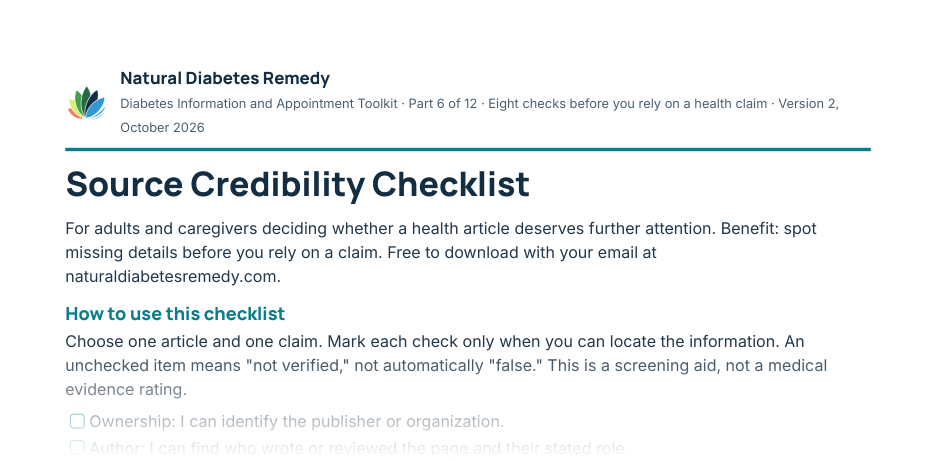
The free Source Credibility Checklist turns the rule into eight checks: ownership, author, date, purpose, what supports the claim, limits, commercial ties and privacy. It works in your browser, and the two-page printable PDF is sent by email after you reply VERIFY.
One evening, step by step.
Here is the card in use on a tired Wednesday, with a made-up practice label.
7:52 p.m. Kettle on. Timer set. Serving size: 1 cup. Servings per container: 2. Stop.
A fictional label with fictional numbers. Not a recommended serving, food choice or target.
- 7:50. The card waits on the counter while the water heats.
- 7:52. Line 1, chosen last night: read one label line. You turn the package over.
- 7:53. You read the serving size, then the servings-per-container line.
- 7:54. Line 3 gets one sentence: “Two servings in the package, not one.” You are not deciding anything about the food.
- 7:55. Line 4 stays empty. Nothing needs an answer tonight.
- 7:56. Timer ends. Box ticked. Done before the water boiled.
Some evenings the action is a claim instead. A video says a bottle can replace your diabetes medicine, so you set two minutes, find out who is responsible, write one line and close the tab. If it still interests you, line 4 becomes: “Is this safe with what I take?”
Reading the unit before the arithmetic is the idea behind food-label numbers start with the units. What you do with a number afterward belongs in that care-team conversation.
The three late-night searches, turned into questions.
Most evenings end in one of these three. Each asks which single thing matters most, and no page can answer that for a body it has never met.
| The search | Why a page cannot answer it for you | What to write on line 4 |
|---|---|---|
| Is it better to eat healthy or exercise? | It depends on your history, your medicines and the week you actually live in. A page can describe options; it cannot choose for your body. | “Which one would help most first, given everything else in my life right now?” |
| Is it better to eat less or exercise more? | This version adds amounts, and amounts are where a stranger's web page is least useful and least safe. | “What would a realistic first change look like for me, and what should I not change on my own?” |
| Is it better to eat before or after exercise? | Timing depends on your routine, your medicines and how you feel that day. One answer will not fit everyone. | “Is there a timing that fits my routine and is safe with what I take?” |
Question prompts for your care team, not answers, and not recommendations about eating or activity.
Each search becomes one sentence to carry into an appointment. Our guide to preparing three questions for your care team puts them in order so the most important one gets asked first.

When a “natural” option shows up.
Your worry is not silly. Money spent on the wrong product is one cost, and harm from something untested is another. Both are checkable before you buy.
The National Center for Complementary and Integrative Health (NCCIH) reviews dietary supplements for diabetes, and the picture is uneven. For selenium, NCCIH reports that a review of four studies found no evidence that it helps with diabetes. For magnesium in supplement form, NCCIH says amounts above the upper limit should not be taken unless a health care provider recommends them. Where reviews of vitamins found any change at all, the authors described the improvements as small and the certainty of the evidence as low.
The FDA's page on spotting health fraud lists warning signs that cost nothing to check:
- Words like “breakthrough,” “new discovery,” “exclusive” or “ancient remedy.”
- A money-back refund offer. The FDA notes that sellers of fraudulent products rarely stay in one place, so a refund costs them little to give.
- Claims of easy or rapid results, and claims that doctors and drug companies are hiding the truth from you.
- Science-sounding jargon that explains nothing you could look up.
Two minutes with that list tells you more than an hour of testimonials. The FDA also keeps a page on illegally sold diabetes treatments, a practical place to look up one product by name, and our article on supplement scams walks through the check in more detail.
Why this page gives you homework instead of a remedy.
You came looking for holistic options and got a card to fill in. That is a fair thing to be annoyed about, so here is the honest reason.
A page that told you exactly what to take or how to change your eating would have to know your body: your history, your medicines, your results, your week. We do not have that, and a site that pretends to is the thing you are right to be wary of. What we can teach in five minutes is the checking, which protects your money while your care team handles the rest.
You may also have met free health information that turned into a sales pitch. Here is what is true today, and you can weigh it yourself.
- The checklist and the planner work in your browser. The printable PDFs and the workbook are sent by email after you reply VERIFY, so those ask for a first name and email.
- We do not ask for health details, and we ask you not to send them.
- Every email has an unsubscribe link, and after the short follow-up series you get at most one email a week, when we publish a new guide.
- Nobody has clinically reviewed this page, and the bar above says so. Our Editorial Policy explains how pages are written and corrected, and the Medical and Educational Disclaimer states the limits plainly.
Common questions.
My doctor said to eat better and exercise. What do I do tonight?
Pick one action for tonight: read one label line, or check one claim. Set a two-minute timer, write one sentence about what you noticed, and tick the box when the timer ends. One checked-off line counts as finishing.
Do I have to give my email address to use the tools?
You can use the Source Credibility Checklist and the Care-Team Conversation Planner in your browser. The printable PDFs and the workbook are sent by email after you reply VERIFY, so those ask for a first name and email.
How can I check a product before I buy it?
Spend two minutes on who is responsible for the claim and whether a date is shown. Then compare the wording with the warning signs the FDA lists for health fraud, and read the NCCIH page on that supplement before you spend money.
Why won't this page tell me what to eat?
Because that answer depends on your history, the medicines you take and your results, which we do not have and do not ask for. A page that guesses is exactly the thing you are right to be wary of.
General education only. This page helps you organize learning and questions. It is not medical advice and does not recommend a treatment, diet, medicine or blood-sugar target. Personal health decisions belong with your care team. Medical and educational disclaimer
Pick the next small thing.
- Five-minute diabetes learning tasks for your evening: ten tasks, each with a done check and a lower-energy fallback.
- Learn about prediabetes in five minutes a day: the same small-session idea stretched into a daily routine.
- Care-Team Conversation Planner: what to do with line 4 when you have more than one question.
Sources and editorial notes
- National Center for Complementary and Integrative Health (NCCIH), Diabetes and Dietary Supplements: What You Need To Know, retrieved October 18, 2026.
- US Food and Drug Administration, How to Spot Health Fraud, retrieved October 18, 2026.
- US Food and Drug Administration, Illegally Sold Diabetes Treatments, retrieved October 18, 2026.
- The five-line card and the two-minute tab rule are adapted from exercises 3 and 4 of our free Seven-Day Everyday Learning Workbook.
Examples are illustrative. Not yet reviewed by a clinician. See our Editorial Policy, Review Methodology and Affiliate Disclosure.
Keep it small, keep it going.
Five-Minute Diabetes Learning Tasks for Evenings
Ten small tasks sized to cook time, each with a one-line check.
Source Credibility Checklist
Check who wrote a claim and what supports it. Free online or as a PDF.
Prepare Three Questions for Your Care Team
Prioritize questions and record a next step.
One line on a card beats two hours of tabs.
The free Seven-Day Everyday Learning Workbook holds seven short exercises built the same way, including a fictional label to practice on and space for three care-team questions.
Free: reply VERIFY to our short email and we send it to you, then 5 short emails, then at most one email a week, when we publish a new guide. Every email has an unsubscribe link.