
Choosing resources
Integrative medicine for diabetes: start with NCCIH.
You searched for holistic options and found sales pages instead. Here is a five-minute way to turn one vague promise into a specific question for your care team.
Education only. This page does not recommend any product, supplement or treatment.
You typed something close to holistic treatment for diabetes near me, and the results were bottles. Up top, a supplement promised to end prediabetes in a few weeks. Further down, a countdown timer. By the third tab, holistic started to look like another word for scam.
That conclusion is fair. You do not have to give up the search because of it. The word itself is not the problem. The problem is that a sales page never has to say what a specific approach is, who would supervise it, or what is actually known about it.
The worry underneath the search is bigger than the word. It is that another year slips by while you do nothing, or that you spend money on something fake and find out too late. A note sheet will not answer that worry for you. It can make the next conversation a lot easier.
This page is education, not treatment advice. It gives you one method and two free public sources: NCCIH, part of the National Institutes of Health, and the US Food and Drug Administration. You will build a two-column note, fill in one row, and leave with a question you can read out loud at your next appointment.

Practice with the free toolkit.
The free Diabetes Information and Appointment Toolkit has twelve parts in one printable book: a start-here guide, the test words you will hear, questions about your results, programs to ask about, label practice, a question builder, a source check, a caregiver pack, a 30-day planner, a glossary, a seven-exercise workbook and a household week planner.
Free, no payment card. Reply VERIFY to our short email and we'll send you the toolkit, then 5 short emails over 12 days (one names our own $9 Fillable Edition), then at most one email a week, when we publish a new guide. Every email has an unsubscribe link.
The short version.
Three steps, one sheet of paper, five minutes.
Pick one offer.
Not every page you saw. One product, one provider, or one sentence you would actually act on.
Check two public pages.
The NCCIH page on diabetes and dietary supplements, and the FDA page on illegally sold diabetes treatments.
Write one question.
The sentence you would say to your care team, in your own words.
Set five minutes, then stop. A note that ends with a question is finished. You do not need an answer today.
Notice the setting before you judge the word.
You will see the word in a few different settings, and the setting tells you more than the word does.
- A shop page. The word sits next to a cart button, a bundle discount or a three-for-two offer.
- A provider page. The word sits next to an appointment form, a fee list and a named person.
- A public agency page. The word sits next to a date, a reference list and a way to contact someone.
None of those settings tells you whether an approach is worth your time. Each one tells you what to ask next. On a shop page, ask what the product is and what is known about it. On a provider page, ask what a first visit involves, what it costs, and whether they will share notes with your doctor.
| What the page says | What you can check |
|---|---|
| “Supports healthy blood sugar” | What is the product, exactly, and what does my care team say about it with the medicines I take? |
| “Holistic provider” | What training do you have, what happens at a first visit, what does it cost, and will you coordinate with my doctor? |
| “Drug-free approach” | What is the approach, and is anyone suggesting I change my prescribed treatment because of it? |
| “Clinically studied ingredient” | Which study, in which people, and what did it find? Is any of that on the NCCIH or FDA pages? |
These are questions to ask, not answers. None of them decides anything about your care.
Build the two-column note sheet.
A sheet of paper and a pen are enough. A phone note works too.
Make two columns.
Left: what it says. Right: what I can check.
Copy the promise, not the page.
One sentence in your own words, plus the page address and today’s date.
Look in two places.
Write the date you checked each source and one line about what it does and does not cover.
Leave blanks as blanks.
Write not checked yet. A blank is an open question, not a failure.
One row per offer. If you check one a day for a week, you will have seven rows. That is usually enough to see the pattern in what you are being sold.
Start with NCCIH’s diabetes and supplements page.
NCCIH is part of the National Institutes of Health. Its public page, Diabetes and Dietary Supplements: What You Need To Know, says plainly that some dietary supplements may have side effects, and some of these, such as kidney damage, can be serious. NCCIH notes that this matters for people with diabetes, because diabetes is the leading cause of kidney disease, and says a health care provider should closely monitor supplement use if you have or are at risk for kidney disease.
The page also says it is very important not to replace medical treatment for diabetes with an unproven health product or practice. That sentence is worth copying into the left column the moment a sales page hints that you can drop your usual care.
One more thing the page does well: it separates studied from shown to work. It describes a 2019 review of 10 studies with 553 participants in which alpha-lipoic acid was no better than placebo for blood sugar, cholesterol or triglycerides in type 2 diabetes. That finding does not tell you what to do. It shows you why a page that says studied has not finished the sentence.
Then open the FDA page.
The FDA keeps a consumer page called Illegally Sold Diabetes Treatments. It describes products sold with diabetes treatment claims that the agency had not evaluated as safe and effective. NCCIH points to the same problem: the FDA is warning consumers about products for diabetes that seem too good to be true, such as those that claim to replace your diabetes medicine. NCCIH says these products are marketed illegally, that some are harmful in themselves, and that all are harmful if people use them in place of effective treatment.
Use the page in two ways. Search the product name before you buy, and write down what you find with the date. Then treat a missing result carefully. A product that does not appear on the page has not been cleared by anyone. It simply was not found there today. Write not found in the right column, not safe.

See one filled row.
Here is a single row, filled in. The page inside it is invented for practice.
One vague promise, turned into one question.
Left column, what it says: “Herbal blood sugar blend. Holistic and drug free. Supports healthy blood sugar.”
Right column, what I can check: product name and maker copied. NCCIH page checked today, date written down: some supplements can have serious side effects, including kidney damage. FDA page checked today: name not found, which is not a clearance. Two questions for my care team.
The question I will ask: “Is this product safe with the medicines I take, and could it affect my kidney tests?”
Made up for practice. It does not describe a real product, page or person, and it recommends nothing.
Notice what the note does not contain: a verdict. It records what was said, where you looked, and what is still open. That is enough to make the appointment easier.
Four questions that fit a short appointment.
You do not need a folder of printouts. Four clear questions on one card are easier to ask.
- What is this approach, in plain words? Ask about the thing you read, not the label on it.
- What is known, and what is not? A short answer is fine. “We do not know yet” is an answer you can use.
- Could it affect my medicines or my kidney tests? Say the product name, or bring the bottle.
- If I want to read more, where would you send me? Write down the source they name and check it later.
None of these asks your care team to approve anything on the spot. They ask for information you can act on, in the time you actually have. Our guide to questions to ask a holistic provider covers the visit itself, before you book.
Why this site asks you to check it too.
If this feels like homework, the feeling is fair. You came looking for options, and this page handed you a note sheet. Here is the honest reason. This site is education, not a clinic. The name includes the word remedy; the content does not promise one, and nobody here can tell you what is right for your body.
You can check that the same way you checked the sales page. Every article carries a byline that says it has not yet been reviewed by a clinician, and a date. The Editorial Policy explains how pages are written. The Review Methodology explains what a review would involve. The free tools work in your browser, and the printable PDF versions come by email after you reply VERIFY. Nothing here asks for your lab results, your medicines or your diagnosis, and you should not send those to any website.
You have probably been burned by a free health page that turned into a sales pitch halfway down. Keep that suspicion. Point it at this page first. The two-column check works on us too.
Quick answers.
Is integrative medicine the same thing as a supplement?
Not in any useful way. On a sales page, the word often sits right next to a bottle and a cart button. The check on this page works on any offer: what is claimed, who says it, what supports it, and what your care team says about it.
Will this page tell me which supplements are safe for me?
No, and no website can answer that for you. NCCIH says a health care provider should closely monitor supplement use if you have or are at risk for kidney disease, and that it is very important not to replace medical treatment for diabetes with an unproven health product or practice. Bring the product name, or the bottle, to your care team or pharmacist.
Do I have to give my email to use anything here?
You can use the web tools in your browser right away. The printable PDF versions come by email after you reply VERIFY to our confirmation message.
What if I already bought something that promised to end prediabetes?
Do not stop or change a prescribed medicine on your own. Bring the bottle or the label to your care team or pharmacist and ask your questions there. The FDA page in the sources below describes products sold with diabetes treatment claims that the agency had not evaluated as safe and effective.
General education only. This page helps you organize learning and questions. It is not medical advice and does not recommend a treatment, diet, medicine or blood-sugar target. Personal health decisions belong with your care team. Medical and educational disclaimer
Where to go next.
Each of these picks up where the note sheet stops.
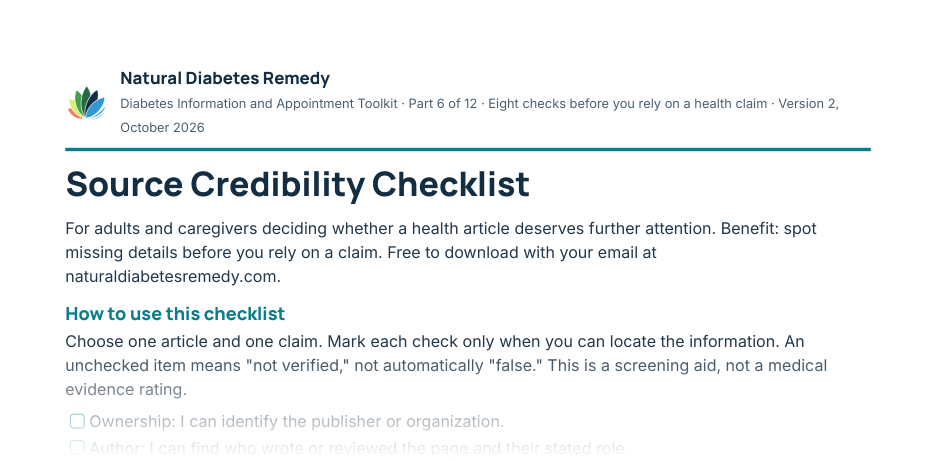
Source Credibility Checklist
Eight checks for one page, a choose-an-action step, a worked example and a review note you can reuse.
Free to use online. The two-page PDF comes by email after you reply VERIFY.
- How to check natural remedy claims safely: compare one claim with what NCCIH and the FDA say, side by side on one page.
- Supplement scams: before you buy: eight credibility checks on a fictional blood sugar ad, with a short note you can keep.
Sources and editorial notes
- National Center for Complementary and Integrative Health (National Institutes of Health), Diabetes and Dietary Supplements: What You Need To Know, retrieved October 18, 2026.
- US Food and Drug Administration, Illegally Sold Diabetes Treatments, retrieved October 18, 2026.
Examples are illustrative. Not yet reviewed by a clinician. See our Editorial Policy, Review Methodology and Affiliate Disclosure.
Check one offer, then stop for today.
Source Credibility Checklist
Check who wrote a claim and what supports it. Free online or as a PDF.
How to Check Natural Remedy Claims Safely
A side-by-side table of what NCCIH and FDA each can tell you.
Questions to Ask a Holistic Provider Before You Book
Three questions, with what a vague answer and a clear one sound like.
New on this topic: How to Read Supplement Facts: A Panel Walk-Through
Start with one useful question.
Get the free Diabetes Information and Appointment Toolkit. No purchase required.
Free: reply VERIFY to our short email and we send it to you, then 5 short emails, then at most one email a week, when we publish a new guide. Every email has an unsubscribe link.