
Getting started
Overwhelmed by prediabetes advice? Sort it into three boxes.
Every page hands you a list. This one helps you put the list on a single sheet, sort it into three boxes, and leave one small task for today.
The worry tends to arrive at night, once the day is finally yours: if I keep putting this off, it turns into diabetes. And if I panic and buy something that promises to end it, I will have wasted the money, or done myself harm, because I never learned how to check it.
By daylight, the prediabetes advice comes from every direction. Read labels. Watch your numbers. Move more. Sleep. Ask your doctor. Check the source before you trust a page. Each item is reasonable on its own. Together they are a pile with no top, so the notebook opens on Sunday and sits under the mail by Tuesday.
This page adds nothing to the pile. You will put the advice you already have on one sheet, sort every line into three boxes — this week, later and not mine yet — and leave exactly one small task for today.
This is education, not a treatment plan. Nothing here tells you what to eat, how much to move, which product to take or what any number means for you. It teaches one skill: sorting advice into a size you can act on, so the decisions stay with your care team.
Practice with the free toolkit.
The free Diabetes Information and Appointment Toolkit has twelve parts in one printable book: a start-here guide, the test words you will hear, questions about your results, programs to ask about, label practice, a question builder, a source check, a caregiver pack, a 30-day planner, a glossary, a seven-exercise workbook and a household week planner.
Free, no payment card. Reply VERIFY to our short email and we'll send you the toolkit, then 5 short emails over 12 days (one names our own $9 Fillable Edition), then at most one email a week, when we publish a new guide. Every email has an unsubscribe link.
Why prediabetes advice piles up.
Advice arrives without a size. “Move more” could mean ten minutes or an hour. A task you cannot finish cannot be checked off, so the pile grows and the worry keeps pace with it.
Prediabetes makes that harder, because there is often nothing to feel. NIDDK notes that people with insulin resistance and prediabetes usually have no symptoms. The reason to act is a test result and a quiet worry, not a signal your body gives you at the end of a long day.

Make one sheet and draw three boxes.
Fifteen minutes, once. After that the sheet does the deciding for you.
Empty the pile onto one sheet.
Notes app, envelope, back of a bill. One task per line, kept short. Do not judge a line yet.
Rewrite anything without a finish line.
“Eat better” never ends, so it can never be checked off. “Read the serving size line on one package” ends.
Ask two questions of every line.
Can I finish this in about five minutes? Does it need an answer from someone who knows my health first? Yes to the second sends it to not mine yet; no to the first sends it to later.
Move exactly one line into today.
One. The rest of the sheet waits, and waiting is part of the method, not a failure.
Your sheet · fill it in
This week: one line you can finish in five minutes
Later: lines that need more time or a habit
Not mine yet: a question for your care team, or a claim to check
Today: the one line you picked
“Not mine yet” does not mean “not important.” It means the answer needs your history, not a stranger’s page. At the start, expect that box to be the fullest. That is a sign the sort is working.
| Box | Goes here | Stays out |
|---|---|---|
| This week | One label line, one claim to check, one question written down. | Anything with an amount, a target or a change to a medicine. |
| Later | Bigger habits, a second resource to compare, a book to look at after the first week. | Anything you would have to rush to finish. |
| Not mine yet | Decisions that depend on your results, your medicines and your history, including whether to start, stop or change anything. | Nothing is thrown away here. Each line becomes a question or a claim to check. |
A sorting guide for your own to-do list, not advice about food, activity, supplements or treatment.
Five suggestions, sorted down to one.
Five things someone might collect in one evening of searching, sorted. Illustrative only, not recommendations.
| Suggestion you picked up | Where it lands | Why |
|---|---|---|
| “Read every label in your kitchen.” | This week, cut down to one package | Every label is a weekend job. One serving size line takes a minute. |
| “Log every meal.” | Later, with a one-line version first | A daily habit starts smaller than a full journal. |
| “Walk every day.” | Later, as a question | How much and when depends on your medicines, your routine and how you feel that day. |
| “Ask your doctor about your A1C.” | Not mine yet, written as one question | It needs your result and your history. Writing the question is the part you can do. |
| “Take the supplement in that video.” | Not mine yet, check the claim first | Someone is selling something. Who is responsible for the claim, and what supports it? |
Illustrative examples only. They do not recommend a food, an activity amount, a supplement or a treatment.
Four lines wait in later or not mine yet. One line stays in this week: read the serving size line on one package tonight.
The five suggestions are fictional examples, not recommendations, and they set no target.
Learn how to read food labels in five minutes.
Week 1 needs one skill, not a course. Turn any package over and find three things, in this order.
Find the serving size, with its unit.
“1 cup,” “3 pieces,” “2 slices.” The unit is the part most people skip.
Find servings per container.
“2” means the package holds two of that serving. “About 3” means the number is rounded.
Read the Total Carbohydrate line.
Grams per serving, not grams for the whole package. Then stop and set the package next to the sheet.
Serving size 1 cup · Servings per container 2 · 18 g carbohydrate per serving
18 g × 2 servings = 36 g for the package. Fictional numbers for practice only: not a recommended serving, food choice or target.
Units come before the arithmetic. That is the idea behind food-label numbers start with the units, and it is why the first task can honestly take a minute.

Thirty days, one small task a day.
The sheet gives you a month of material. You need one line for today and a way to choose tomorrow’s.
- One line a day. Set a timer for five minutes and stop when it ends, even if you are curious.
- Two kinds of task alternate. Read one label line, or check one claim. Neither asks you to decide anything.
- Nothing new is added until a box empties. The sheet is the limit, not your memory.
| Week | Focus | What a day looks like |
|---|---|---|
| Week 1 | One label line | Find the serving size line on one package, then stop. |
| Week 2 | One claim checked | Find who is responsible for a page and whether a date is shown. The Source Credibility Checklist gives you eight checks for this. |
| Week 3 | One question written | Turn a line from not mine yet into a sentence for your next visit, using our guide to preparing three care-team questions. |
| Week 4 | One line from later | Take the smallest item that has been waiting and give it its own day. |
A suggested practice order you can reorder freely. It is not a treatment plan and sets no health target.
Missed days will happen. A missed session is information for adjusting the plan, not proof that you cannot do this. On a sideways evening, use the two-minute version: read one line, close the page.
If drawing the sheets sounds like one more task, the $9 Fillable Edition collects seven fillable worksheets, including a label sheet and a care-team visit sheet with a medicine list. It is our own paid product and it is optional. The free Seven-Day Everyday Learning Workbook covers the same skills on paper, and every step on this page works with a plain sheet of paper.
Why this page hands you homework.
You came looking for options and got a sorting sheet. That is a fair thing to be annoyed about, so here is the honest reason.
A page that told you what to take, how much to move or which plan to follow would need your history, your medicines and your results. We do not have them, and we do not ask you to send them. A site that guesses is exactly what you are right to be wary of. What a page can teach without your history is the checking: who is responsible for the claim, what supports it, and which question to carry into the room.
You may also have met free health information that turned into a sales pitch. Here is what is true here, so you can weigh it.
- The checklist and the planner work in your browser. The printable PDFs and the workbook are sent by email after you reply VERIFY.
- We do not ask for health details, and we ask you not to send them.
- Every email has an unsubscribe link, and after the short follow-up series you get at most one email a week, when we publish a new guide.
- Examples are labeled fictional, and nobody has clinically reviewed this page yet; the bar above says so. The Editorial Policy explains how pages are written and corrected.
When a bottle lands in your pile, sort it into not mine yet and spend two free minutes on it. The NCCIH page on diabetes and dietary supplements describes the evidence as limited, and the FDA page on illegally sold diabetes treatments explains that some products are sold with claims that are not allowed. If the claim still interests you, it becomes one question for your care team before any money is spent.
Common questions.
I have a list of forty things. Where do I start?
Put every line on one sheet, then sort each line into this week, later or not mine yet. Move exactly one line into today, and choose something you can finish in about five minutes, such as reading one serving size line.
Do the free tools need my email address?
The Source Credibility Checklist and the Care-Team Conversation Planner work in your browser. The printable PDFs and the workbook are sent by email after you reply VERIFY, so those ask for a first name and an email address.
Why won’t this page tell me which option to choose?
Because that answer depends on your history, the medicines you take and your results, which we do not have and we do not ask for. The sorting teaches the checking; the decisions stay with your care team.
General education only. This page helps you organize learning and questions. It is not medical advice and does not recommend a treatment, diet, medicine or blood-sugar target. Personal health decisions belong with your care team. Medical and educational disclaimer
Sources and editorial notes
- National Institute of Diabetes and Digestive and Kidney Diseases (NIDDK), Insulin Resistance and Prediabetes, retrieved October 18, 2026.
- National Center for Complementary and Integrative Health (NCCIH), Diabetes and Dietary Supplements: What You Need To Know, retrieved October 18, 2026.
- US Food and Drug Administration, Illegally Sold Diabetes Treatments, retrieved October 18, 2026.
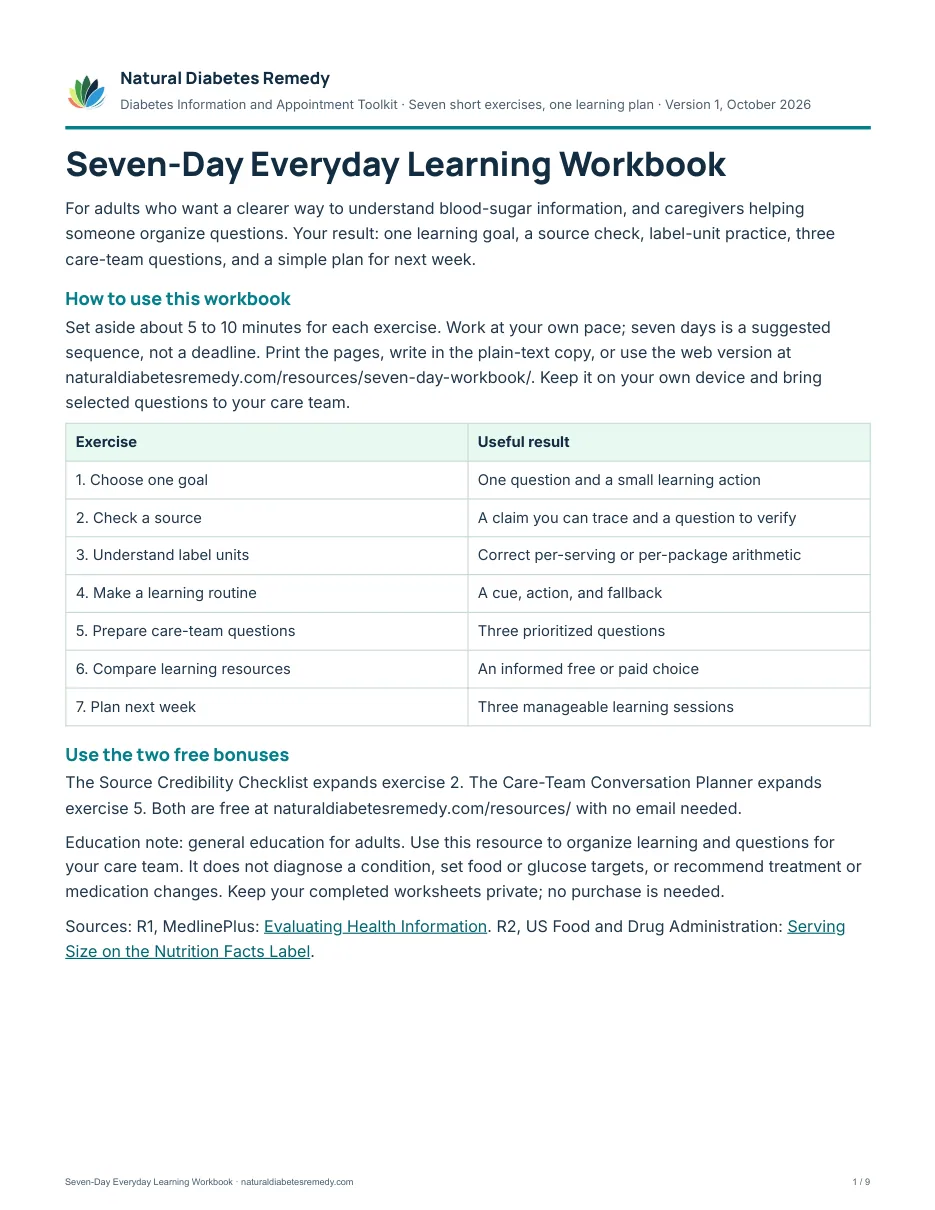
- The one-sheet sort follows the same pattern as the free Seven-Day Everyday Learning Workbook, where every exercise has a finish line you can see.
Examples are illustrative. Not yet reviewed by a clinician. See our Editorial Policy, Review Methodology and Affiliate Disclosure.
Keep it small, keep it going.
A Beginner's Prediabetes Learning Plan
Choose one question and a manageable learning sequence.
Learn About Prediabetes in Five Minutes a Day
Seven short reads, a cue and a fallback.
Source Credibility Checklist
Check who wrote a claim and what supports it. Free online or as a PDF.
One sheet, three boxes, one task today.
The free Seven-Day Everyday Learning Workbook holds seven short exercises built the same way, including a fictional label to practice on and space for three care-team questions.
Free: reply VERIFY to our short email and we send it to you, then 5 short emails, then at most one email a week, when we publish a new guide. Every email has an unsubscribe link.