
Free toolkit · no purchase
Get the free Diabetes Information and Appointment Toolkit.
Just told you have prediabetes or type 2 diabetes? A page of lab results can be heavy on words like A1C and fasting glucose and light on what they mean. This free printable toolkit starts with those words, then helps you turn them into three questions for your care team.
Access terms: free, no payment card. Reply VERIFY to our short email and we email you the toolkit link, then 4 short emails over about 10 days. Every email has an unsubscribe link.
What is included
Print one part, not all twelve.
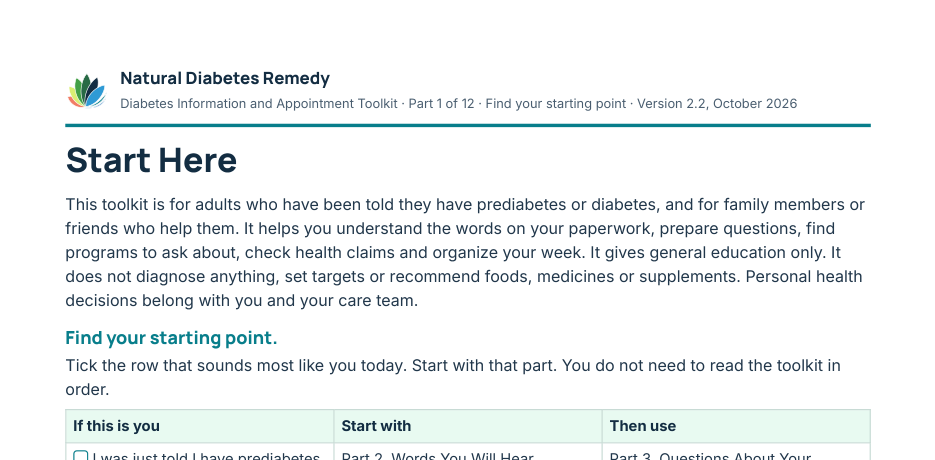
Part 1, Start Here, matches your situation to the part to begin with and gives you a first 10-minute session. If you print only one page today, print that one. Each row below says what you finish with, so you can leave the rest until a question of your own sends you back.
| Part | What you finish with | Formats | How to get it |
|---|---|---|---|
| 1. Start Here | Your starting point and a first 10-minute session | PDF (2 pages), large print, text | Free with your email |
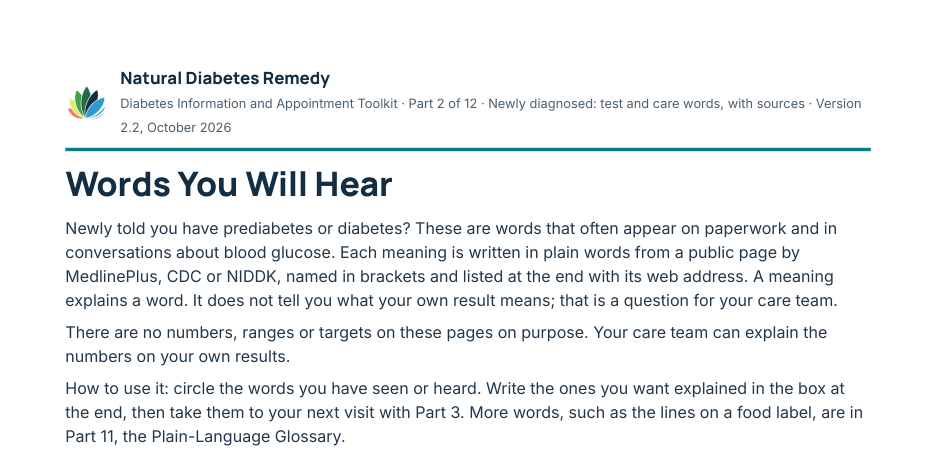
| 2. Words You Will Hear | Plain meanings of A1C, fasting plasma glucose and other test and care words, each from MedlinePlus, CDC or NIDDK | PDF (3 pages), large print, text | Free with your email |
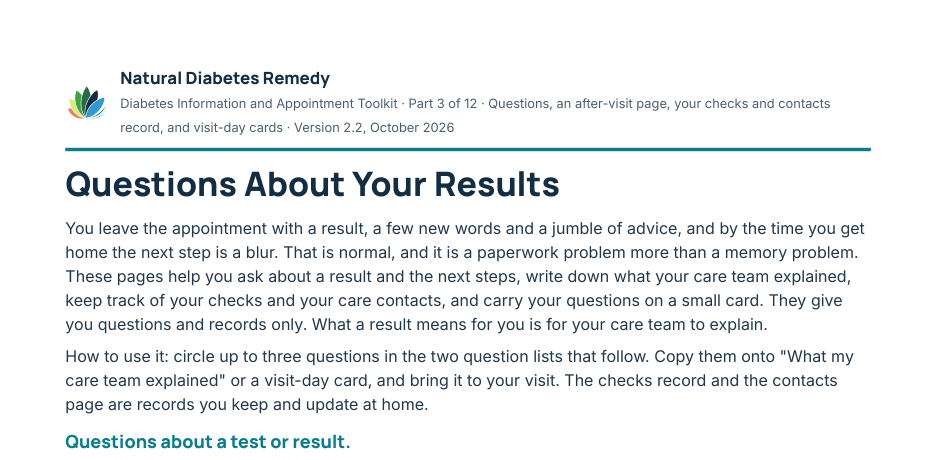
| 3. Questions About Your Results | Questions about a test, the next check and next steps, a page for what your care team explained, a record of your checks with dates and who arranges them, a care-contacts and medicines page, and four visit-day cards | PDF (7 pages), large print, text | Free with your email |
| 4. Programs to Ask About | What CDC says about DSMES and the National DPP lifestyle change program, eligibility and cost questions, and checked program-finder links | PDF (2 pages), large print, text | Free with your email |
| 5. Care-Team Conversation Planner | Three prioritized questions, the answers and the agreed next step | Web question builder, PDF (2 pages), large print, text | Web version in your browser; files free with your email |
| 6. Source Credibility Checklist | Eight checks on one claim, with a box for supplement and remedy claims | Web tool, PDF (2 pages), large print, text | Web version in your browser; files free with your email |
| 7. Food-Label Practice | Six fictional labels (one with a net-carbs line), a real-package checklist and an answer key | Web tool (five labels), PDF (5 pages), large print, text | Web version in your browser; files free with your email |
| 8. Seven-Day Everyday Learning Workbook | Seven short exercises, from one goal to next week’s plan | Web version, PDF (9 pages), large print, text | Web version in your browser; files free with your email |
| 9. 30-Day Learning Planner | One small information task a day, with weekly reviews | PDF (7 pages), large print, text | Free with your email |
| 10. Caregiver Preparation Pack | Agreed roles, a shared question list and an after-visit page | PDF (6 pages), large print, text | Free with your email |
| 11. Plain-Language Glossary | 50 label, information and appointment terms, each with its source | Searchable page, PDF (6 pages), large print, text | Web version in your browser; files free with your email |
| 12. Household Week Planner | A weekly meal grid, a shopping list, a prep-session checklist and a container check, with no foods chosen for you | PDF (2 pages), large print, text | Free with your email |
| The whole toolkit in one book | All 12 parts in one bookmarked PDF, with a contents page | PDF (54 pages), large print (101 pages), text | Free with your email (also linked in the email) |
| Everything in one file | The book and every single part, in all three formats | ZIP (about 5.9 MB) | Free with your email (also linked in the email) |
What changed in version 2 (October 19, 2026): added Parts 1 to 4 and Part 12, a sixth practice label with a net-carbs line and a real-package checklist in Part 7, a supplement and remedy box in Part 6, links between the parts, a care note on every printed page, and the whole toolkit as one PDF book. Version 1 files still download from their old links.
Not included yet: short video or audio lessons. They will be added only after they are made and checked.
Start with the words
Part 2 is built for the sheet in your hand.
Words You Will Hear gives a plain meaning for each term and prints the public source it came from beside it, either MedlinePlus, CDC or NIDDK. The meanings are written to be read once, not memorized. You find the word on your handout, read two lines, and put the page back in the folder with your results.
Three ways to use it.
Circle the words you cannot place.
Go through the handout with a pencil before you read anything else. A1C and fasting plasma glucose are both in Part 2, each with a plain meaning and the source beside it, and so are the other test and care words listed there.
Keep the page with the handout.
The meanings help most when they sit next to the words they explain, so fold or staple them together and keep both where you can find them again.
Carry what is left to your next visit.
Anything still unclear becomes one line on your question sheet. That is what Part 3 is for, and three questions are enough to start with.
This is education, not treatment. Nothing in the toolkit tells you what to eat, which medicine or supplement to take, or what your numbers should be. The questions are yours to ask; the answers come from your care team.
If you have been let down by a page that started as free information and turned into a pitch, this is a fair thing to check: every document says who wrote it and that no clinician has reviewed it yet. Each meaning also names its source, so you can look up the same wording yourself and decide whether it is worth keeping.
Prefer a screen to a printer? The Plain-Language Glossary is a searchable page of label, information and appointment terms, each with its source.
Quick start
Try a five-minute task first.
If twelve parts feels like a lot, skip the printing for now and open one tool. Each one runs in your browser with nothing to install, and what you type stays in the tab until you reload the page.
Read a fictional label
Three questions and the reasoning behind each answer.
Build a question list
Mark your top three and see them with space for answers.
Check one claim
Eight checks and a summary of what you found.
If you came looking for a remedy
A promise is the moment to slow down.
Many people reach a page like this after a friend, an ad or a video has described something that sounds like a simple answer. That search makes sense, and the toolkit does not judge it. The toolkit is education, not treatment: it does not recommend a supplement, a remedy or a food plan. What it gives you is a way to look at a claim before you spend money on it, and a place to write down what you want to ask.
Check the source first.
Part 6 walks you through eight checks on one claim at a time, has a box for supplement and remedy claims, and shows a worked example on an invented article that makes a strong promise.
Then take it to a person.
Part 3 turns what you found into questions about a test, the next check and next steps, with room to write down the answers you get.
Ask about programs, not products.
Part 4 sets out what CDC says about DSMES and the National DPP lifestyle change program, with eligibility and cost questions to bring to your care team.
None of the twelve parts changes a diagnosis, recommends a treatment or replaces a visit with your care team. They help you organize what you want to ask.
If the checklist itself feels like one more chore on a tired evening, start with the one claim that is already bothering you and set the rest aside. Part 6 is two pages, the checks go in order, and one claim is enough to practice on.
A look inside
See the actual pages.
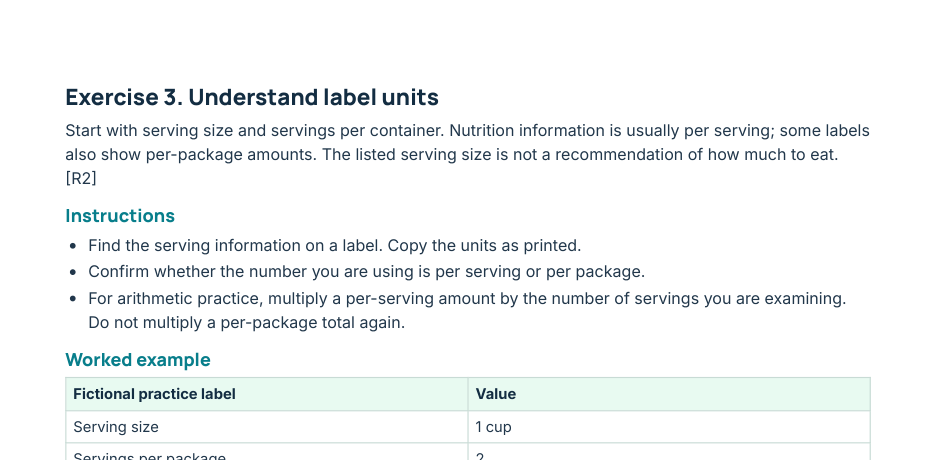
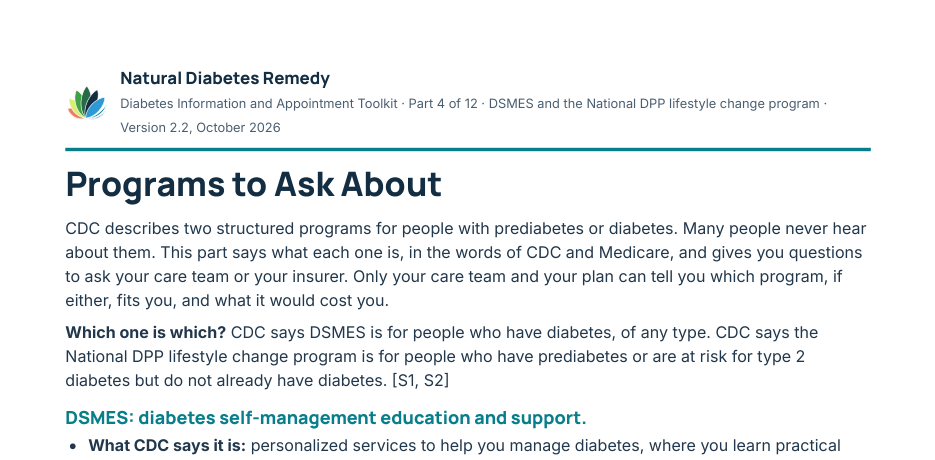
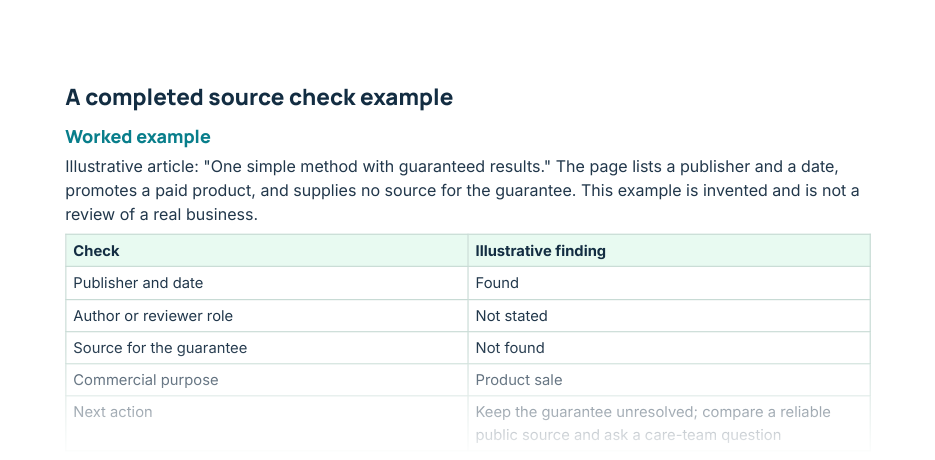
All examples use invented details. Nothing in the toolkit recommends a serving, food, medicine or blood-sugar target.
Send me the toolkit.
Type your first name and email, and we’ll send you a short email. Reply VERIFY to it and we’ll email you the toolkit, free to keep. You do not have to read all twelve parts at once: print the one that matches the question you have today and come back for the others when you need them.
- Free, no payment card
- The whole toolkit as one printable book, plus every part on its own
- Large-print and text versions of everything
- Then 4 short emails over about 10 days, each with an unsubscribe link; one names our own $9 Fillable Edition, and there are no affiliate links
- We never ask for health details
Why give your email? You get one link to every download (the whole book, the 12 single parts in three formats and a ZIP), so you can find them again later. Single files on Free Resources also ask for your email, and we email each one to you once you have replied VERIFY.
Your first name and email address go to our email service (HighLevel) so we can send the link and the 4 short emails, and greet you by name. Privacy Policy
Get the free toolkit
Before you start.
Do I need to give my email to use the tools?
The label practice, question builder and source check open in your browser right away. Every single file on Free Resources asks for your first name and email first, and we email it to you once you reply VERIFY to our short email. A toolkit request gets you one emailed link to every download instead.
What is new in version 2?
Version 2 (October 19, 2026) adds Start Here, Words You Will Hear, Questions About Your Results with visit-day cards, Programs to Ask About (DSMES and the National DPP), the Household Week Planner, a sixth practice label with a net-carbs line, and the whole toolkit as one PDF book. Version 2.1 (October 23, 2026) adds two record pages to Questions About Your Results: a checks record (dates and who arranges each check, no results) and a care-contacts and medicines page you keep at home. Version 2.2 (October 24, 2026) makes the files easier to use: a larger footer with the version and page number on every page, a contents page you can click in the book, clickable web addresses, and a shorter Food-Label Practice (5 pages). Version 1 files still download.
Do I need to buy anything?
No. Everything in the toolkit is free to keep. Our one paid product, the $9 Fillable Edition of extra worksheets, is optional.
Which emails will I get?
First, a short email that asks you to reply VERIFY. Once you do, the toolkit email, then 4 short emails over about 10 days on using the toolkit, and then the series stops. One names our own $9 Fillable Edition once, and there are no affiliate links. Every email has an unsubscribe link at the bottom. If you unsubscribe, you keep the full toolkit.
Is anything I type saved?
No. The web tools keep what you type only in your browser tab, and reloading clears it. The PDFs are files you keep. We only receive the first name and email address you type into the request form, and your VERIFY reply.
Has a clinician reviewed the toolkit?
Not yet. It was written by our editorial team with AI assistance from public sources such as the FDA and MedlinePlus. Every document says so. See our Editorial Policy.
General education only. This page helps you organize learning and questions. It is not medical advice and does not recommend a treatment, diet, medicine or blood-sugar target. Personal health decisions belong with your care team. Medical and educational disclaimer
Start with the words on your lab report.
Get the free toolkit link by email, or try one of the three web tools in your browser right now.
Free: reply VERIFY to our short email and we send it to you, then 4 short emails. Every email has an unsubscribe link.