
Choosing resources
Conflicting health advice online? Compare two sources on one page.
You do not need to read every page tonight. You need one question, two sources and a three-line note you can close the laptop on.
Education only. No product, supplement or treatment is recommended here.
You come home from the dental office, still in your work clothes, and the only instruction you can remember from your own appointment is “eat better and exercise.” By nine o’clock you have a row of tabs open, two of them say opposite things about bread, and nothing is checked off.
One page says drop the bread. Another says the bread is fine and the trouble is something else. A third agrees with both, then offers a bottle at the bottom. Every one sounds certain. Not one tells you what to do before bed.
The problem is not that you cannot follow advice. It is that you are holding two pages from two different worlds in your head, with nothing written down. This page offers a smaller version: one question, two sources, one sheet, then a three-line note so the laptop can close.
Practice with the free toolkit.
The free Diabetes Information and Appointment Toolkit has twelve parts in one printable book: a start-here guide, the test words you will hear, questions about your results, programs to ask about, label practice, a question builder, a source check, a caregiver pack, a 30-day planner, a glossary, a seven-exercise workbook and a household week planner.
Free, no payment card. Reply VERIFY to our short email and we'll send you the toolkit, then 5 short emails over 12 days (one names our own $9 Fillable Edition), then at most one email a week, when we publish a new guide. Every email has an unsubscribe link.
The short version.
You can stop after this section and still do the whole thing tonight. It fits in three steps.
Pick one question.
Something small and answerable, in your own words. Write it on one line at the top of a page.
Put two sources under it.
Source A on the left, source B on the right. Write who wrote each one, who paid for the page, and the date.
Write the point they share.
One plain sentence both pages would sign. If they share nothing, write that instead.
Two sources, then stop. A third page tonight adds reading, not clarity. The note is the task.
Start with one question you can finish.
Most evenings go wrong at the search box. “What should I eat with prediabetes” cannot be answered by one page, so every page answers a different part of it, and you keep reading to see if the next one says it better.
Narrow the search to something one page can answer, and small enough to finish tonight.
| Too wide for one evening | Workable tonight |
|---|---|
| Should I stop eating bread? | What does the Total Carbohydrate line on the bread label in my cupboard include? |
| Is this supplement safe for me? | Does this seller name an author, a date or a source for its claim? |
| What is the right way to eat? | What does one serving mean on the cereal box in front of me? |
Practice questions for this exercise. They do not recommend a food, a product or a way of eating.
Keep the question in a note on your phone. When a page does not answer it, close the page. If a new question appears while you read, write it under tomorrow’s date instead of opening another tab. That one habit is most of the method.
Build the two-column note.
One sheet of paper is enough. Draw a line down the middle, write Source A on the left and Source B on the right, then fill the same five lines for each one.
| Line to fill | Source A | Source B |
|---|---|---|
| Who wrote it | a name and a role, or no name | a name and a role, or no name |
| Who paid for the page | ads, sponsor, shop, order button | ads, sponsor, shop, order button |
| The date | published or updated, and the year | published or updated, and the year |
| What it points to | the link it leans on | the link it leans on |
| The plain point, in my words | one sentence | one sentence |
A reading checklist, not a rating. A missing line is not proof a page is wrong. It means you do not know yet.
MedlinePlus, the consumer health site from the National Library of Medicine, suggests asking who runs a site, what the page is for, who pays for it, where the information comes from and whether it is current. The five lines are those questions in everyday words.
The byline or About page gives the author. Ads, a shop link, an order button or a discount code show who paid. The date sits near the headline or in the footer. Open the link the sentence leans on and read the part that matters; a government page about food in general does not support a sentence about one bottle.
Under the table, write one more line: the point both sources share. That is the part you can carry into a conversation. If the two pages split on the same question, write the split in one line: they disagree about this, and here is what I still need to ask.
Spot false claims in ads and media.
False health claims in advertisements rarely announce themselves. They arrive as a story, a video or a comment that sounds like a friend.
- One product offered for several unrelated problems.
- The word natural used as a promise of safety.
- Personal stories in place of sources.
- A discount that ends tonight.
- No mention of who should not use it, or of the medicines you already take.
The FDA keeps a consumer page on illegally sold diabetes treatments. It describes products sold with treatment claims that the agency had not evaluated as safe and effective. If a page matches that description, you have an answer without spending anything.
False health claims in the media work more quietly. A headline reports a finding, and the finding came from a small study, an animal study, or a study paid for by a company with an interest in the result. MedlinePlus suggests asking whether the research involved people or animals, how many people took part, how long it lasted, what type of study it was and who paid for it. If the article cannot tell you, write not verified and keep the question open.
See what a filled note looks like.
This example is invented. Both sources are made up for practice.
One question, two made-up pages
My question: what does the serving line mean on the cereal box in my cupboard?
Source A: a grocery store blog. No author. Updated 2024. A shop link and a sign-up box at the bottom. Points to nothing else.
Source B: a government consumer page. Author listed as the agency. A date shown on the page. Nothing for sale. Points to its own longer guidance.
The point both share: start with the serving line before reading any other number.
What I still do not know: what the number means for me, and what to do with it this week.
Made up for practice. No real store, agency, person or result is described.
Notice what the note does not contain: a verdict. It ends with what you know, what is missing and one question you can carry to your care team.
Close the laptop with three lines.
Before you stop for the night, write three lines and leave them where you will see them.
What I checked.
The question, and the two sources in one line each.
What they share.
The sentence both pages would sign, or the subject they split on.
What I will ask.
One question for your care team, written as a question rather than a worry.
That is the whole evening’s work. It takes about five minutes once the sheet is in front of you, and it ends with something checked off instead of a screen still open.
Tomorrow, do one small thing instead of a fourth page: read one label, or check one claim on one page. The five-minute learning routine shows how to set a cue and a fallback, and the free Seven-Day Everyday Learning Workbook has a page for planning three sessions on paper.
Why a site like this asks you to check it.
You came looking for holistic treatment options, and this page handed you a note sheet. That is fair to be annoyed about. Here is the honest reason.
This site is education, not a clinic. It helps you check sources, read food-label units and prepare questions. The name includes the word remedy; the content does not promise one. NCCIH, part of the National Institutes of Health, advises people to talk with their health care providers about any complementary health approaches they use, so decisions can be shared and well informed. Nobody has clinically reviewed this page yet, and the bar above the article says exactly that.
About the sales-pitch worry: the checklist works in your browser, and a PDF copy comes by email after you reply VERIFY. One paid product exists, a $9 fillable workbook set described on its own page, and the free toolkit is complete without it. Nothing here asks for your results, your medicines or your diagnosis.
Our Editorial Policy describes how pages are written. Point the same suspicion you use on other pages at this one first. That is not a problem for us; it is the method.
Keep the sheet, skip the verdict.
Fold the note into your bag, or photograph it and close the tabs. Bring it to your next appointment and read line three aloud. A written question is easier to ask than a half-remembered page, and it is the part your care team can work with.
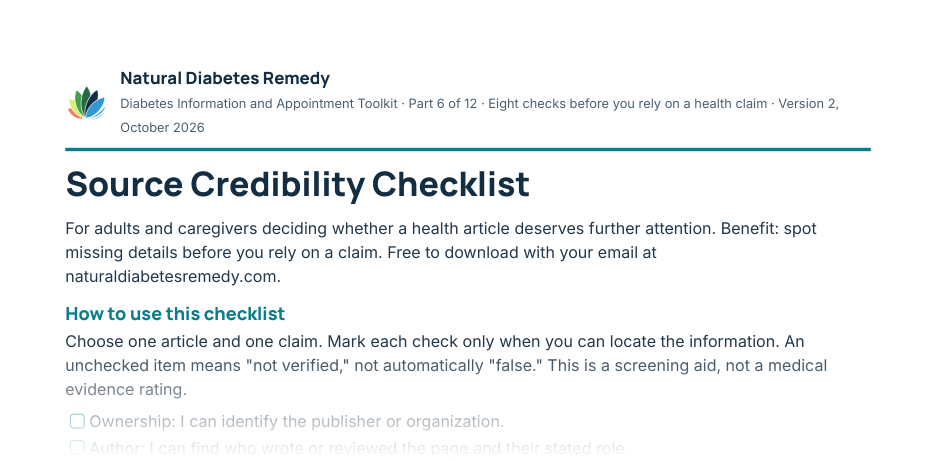
Source Credibility Checklist
Eight checks for one page, a choose-an-action step, a worked example and a review note you can reuse.
Free to use in the browser. The two-page PDF comes by email after you reply VERIFY.
Quick answers.
How do I compare conflicting online health advice without reading for hours?
Pick one question and two sources. Write who wrote each one, who paid for the page and the date. Then write the one plain point both share, and stop when the note has three lines.
How can I spot false health claims in the media?
Slow down on a headline that promises a big result. MedlinePlus suggests asking whether the research involved people or animals, how many people took part, how long the study lasted, what type of study it was and who paid for it. If the story cannot answer those questions, write not verified and keep the question open.
How can I spot false health claims in advertisements?
Look at who is selling. An order button, a discount that ends tonight, one product offered for unrelated problems and stories in place of sources are reasons to pause. If you cannot tell who paid for the page, write not verified instead of guessing.
Do I have to decide anything tonight?
No. The note is the task. Bring it to your care team and let the decisions happen there. A blank line in the note is a question to ask, not a failure.
General education only. This page helps you organize learning and questions. It is not medical advice and does not recommend a treatment, diet, medicine or blood-sugar target. Personal health decisions belong with your care team. Medical and educational disclaimer
Sources and editorial notes
- MedlinePlus (National Library of Medicine), Evaluating Health Information, retrieved October 18, 2026.
- National Center for Complementary and Integrative Health, Diabetes and Dietary Supplements: What You Need To Know, retrieved October 18, 2026.
- US Food and Drug Administration, Illegally Sold Diabetes Treatments, retrieved October 18, 2026.
Examples are illustrative. Not yet reviewed by a clinician. See our Editorial Policy, Review Methodology and Affiliate Disclosure.
Two sources tonight, then stop.
Source Credibility Checklist
Check who wrote a claim and what supports it. Free online or as a PDF.
Learn About Prediabetes in Five Minutes a Day
Seven short reads, a cue and a fallback.
Before You Trust a Health Article, Check One Claim
Publisher, author, date, support and commercial ties.
New on this topic: Report a False Supplement Claim: Where to Go
Start with one useful question.
Get the free Diabetes Information and Appointment Toolkit. No purchase required.
Free: reply VERIFY to our short email and we send it to you, then 5 short emails, then at most one email a week, when we publish a new guide. Every email has an unsubscribe link.