
Getting started
What is insulin resistance? Write it in your own words.
One dense article, one lunch break, one card: copy the term, write it plainly from a public source, and turn it into a question for your care team.
You have twenty minutes at lunch and you want to understand what your last appointment meant. You open one article about prediabetes, and by the third paragraph it is using words like insulin resistance and glycemic index as if you already know them. You close the tab feeling tired, and a little behind.
You are not behind. That article was written for people who already speak the language. This page is for the other twenty minutes: one term at a time, written down in your own words, turned into one question you can carry into your next visit.
That is the whole method. About five minutes per term, one public source, and a result you can use.
This is education, not a treatment plan. Nothing here tells you what to eat, which medicine or supplement to take, or what any result means for your body. It teaches one skill: taking a term you met at lunch and turning it into a question for the people who know your history.
One term is usually three plain sentences.
“Insulin resistance” sounds like one fact. It is really three, and a public source states each of them in a sentence short enough to copy.
- Insulin is a hormone made by your pancreas.
- Insulin resistance is a condition in which your body doesn’t respond to insulin the way it should.
- Prediabetes means blood glucose levels, also called blood sugar levels, are higher than normal but not high enough to be diagnosed as type 2 diabetes.
Those three sentences come from the National Institute of Diabetes and Digestive and Kidney Diseases (NIDDK) page on insulin resistance and prediabetes, retrieved October 18, 2026. You do not have to hold the rest of that page in your head at 12:45 on a Tuesday.
The useful difference is between recognizing a sentence and owning one. Recognizing is reading. Owning is saying the same idea in words you would actually use out loud.
Practice with the free toolkit.
The free Diabetes Information and Appointment Toolkit has twelve parts in one printable book: a start-here guide, the test words you will hear, questions about your results, programs to ask about, label practice, a question builder, a source check, a caregiver pack, a 30-day planner, a glossary, a seven-exercise workbook and a household week planner.
Free, no payment card. Reply VERIFY to our short email and we'll send you the toolkit, then 5 short emails over 12 days (one names our own $9 Fillable Edition), then at most one email a week, when we publish a new guide. Every email has an unsubscribe link.
Build a five-minute jargon card.
Four lines, one term, and a timer set for five minutes so the break stays a break. This is what insulin resistance explained simply looks like on paper: short, unfinished and yours.
Line 1: the term, copied exactly.
Not your version yet. Copy the word as it appears, so you can look it up later and spell it to yourself.
Line 2: where the plain sentence came from.
Source name, page address and the date you opened it. Three pieces, one line.
Line 3: your own words.
One sentence you would say to a coworker. No copying, and no adding advice.
Line 4: one question.
One sentence for your care team, or leave it blank. Blank is allowed.
The card · fill it in
1. The term: copy the word exactly
2. I read it here: source name, page address, date opened
3. In my own words: one sentence you would say out loud
4. My question: one sentence, or leave it blank
If line 3 will not come, that is a result, not a failure. It usually means the page you opened was written for specialists. Close it and open a public source instead: the NIDDK page above, MedlinePlus, or the plain-language glossary on this site.
Two terms in one lunch break.
Here is the card in use during a made-up lunch break. The times are illustrative, and the words in line 3 belong to a practice card, not to you.
Term: insulin resistance. My words: my body does not answer insulin the way it should.
Written from the NIDDK page named in the sources. A practice card only, not a diagnosis, a target or a plan.
- 12:41. Timer set. Term copied: insulin resistance.
- 12:43. The NIDDK sentence found; line 2 gets the source and the date.
- 12:45. Line 3 written on the first try, in words you would say to a coworker.
- 12:46. Timer ends. Card closed. Back to the schedule.
Term two comes from the same page, because taking two things from one source is easier than starting somewhere new.
Term: prediabetes. My words: my blood sugar is higher than normal, but not high enough to be called type 2 diabetes.
Wording follows the NIDDK page in the sources. Illustrative practice only; it says nothing about your own results.
Line 4 on that second card read: “Ask what my last result actually was.” That stub is the most useful line on the page. It says what you want to understand, in your voice, before anyone uses a word you have to look up again. If the afternoon runs over and a card stays half-finished, that is information for adjusting the plan: put it on top of your bag for tomorrow instead of starting a new one.
Turn your line into one question.
A question is easier to ask than a topic is to raise. Three parts make one work: name what you read, ask whether it applies to you, ask what comes next.
Name the sentence you read.
“I read that insulin resistance means the body does not respond to insulin the way it should.” Naming it shows your care team what you already have in front of you.
Ask whether it applies to you.
“Is that part of what we are watching for me?” You are asking for the connection, not for a label.
Ask what comes next.
“What would you want to check at my next visit?” That keeps the answer with the people who have your history.
Put together, line 4 might read: “I read that insulin resistance means my body does not respond to insulin the way it should. Is that part of what we are watching for me, and what would you want to check next?” One sentence, two ideas, no guessing.
Three questions is usually plenty for one appointment. Our guide to preparing three questions for your care team puts them in the order that gets the first one answered, and the free Care-Team Conversation Planner gives each question its own space on paper.
Where to read the plain version.
Three places are enough. You do not need a dozen tabs.
- The NIDDK page on insulin resistance and prediabetes, written for the public by a federal agency.
- MedlinePlus, Prediabetes, for the same ideas in shorter sentences.
- Our plain-language glossary, one term at a time, when a single word is all you need explained.
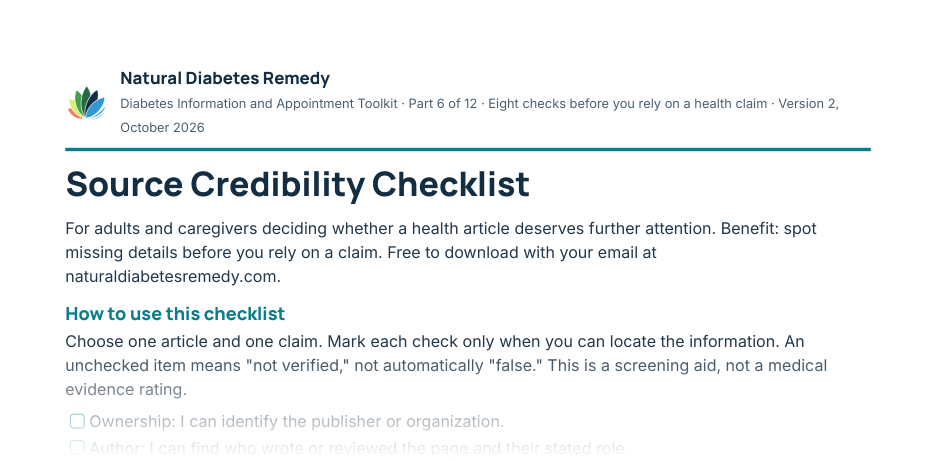
One caution about any page, including ours: check who is responsible for it before you write a line from it. The free Source Credibility Checklist turns that check into eight short questions: ownership, author, date, purpose, what supports the claim, limits, commercial ties and privacy.
The checklist works in your browser. Its two-page printable PDF comes by email after you reply VERIFY.
Why this is homework, not a remedy.
You came looking for holistic options and got a card to fill in. That is a fair thing to be annoyed about, so here is the honest answer.
A page that told you what to take, or exactly what to change, would need your history, the medicines you take, your results and the week you actually live in. We do not have that, and we do not ask for it. A site that guesses for a body it has never met is the kind of site you are right to be wary of, especially if it is selling something alongside the guess.
What can be taught in five minutes is the checking: how to find a public source, how to write a term in your own words, how to notice a page that promises to end a disease. That skill protects your money while your care team handles the decisions.
About the sales pitch, since you have been burned before. This site has one paid product, the $9 Fillable Edition of the learning toolkit, described on its own page; the free workbook and the browser tools are complete without it. We do not ask for health details and we ask you not to send them. Every email has an unsubscribe link, and after the short follow-up series you get at most one email a week, when we publish a new guide. This page has not been checked by a clinician; the bar at the top says so, and the Editorial Policy explains how pages are written and corrected.
Common questions.
What is insulin resistance in simple words?
The National Institute of Diabetes and Digestive and Kidney Diseases (NIDDK) describes insulin resistance as a condition in which your body does not respond to insulin the way it should. Insulin is a hormone made by your pancreas. Your own version might be: my body does not answer insulin the way it should. Write yours from a source you opened, not from memory.
Is insulin resistance the same thing as prediabetes?
They are connected but not the same. NIDDK says prediabetes means blood glucose levels are higher than normal but not high enough to be diagnosed as type 2 diabetes, while insulin resistance is about how the body responds to insulin. Whether either applies to you is a question for your care team.
Where can I find insulin resistance explained for beginners?
Start with the NIDDK page listed in the sources below and the MedlinePlus prediabetes page. Both are written for the public rather than for specialists. Read one section, write one line in your own words, and stop.
Do I also have to understand glycemic index?
Only if it turns up in something you are reading. The card works the same way for any term: copy it, find the defining sentence in a public source, write your version, then write one question. This page does not define glycemic index; the source you open should.
Why does this page give me homework instead of a treatment plan?
Because a plan for your body needs your history, the medicines you take and your results, which we do not have and do not ask for. The card teaches the part you can do alone: reading a public source and turning it into a question your care team can answer.
General education only. This page helps you organize learning and questions. It is not medical advice and does not recommend a treatment, diet, medicine or blood-sugar target. Personal health decisions belong with your care team. Medical and educational disclaimer
Pick the next small thing.
- A beginner’s prediabetes learning plan: where this card fits across a first month of short sessions.
- Learn about prediabetes in five minutes a day: the same small-session idea stretched into a daily habit.
- Seven-Day Everyday Learning Workbook: seven exercises built the same way, including a fictional label to practice on.
Sources and editorial notes
- National Institute of Diabetes and Digestive and Kidney Diseases (NIDDK), Insulin Resistance & Prediabetes, retrieved October 18, 2026. Source of the wording used for insulin, insulin resistance and prediabetes in this article.
- MedlinePlus, Prediabetes, retrieved October 18, 2026. Suggested as a shorter plain-language place to read next.
- The four-line jargon card adapts the one-goal exercise in our free Seven-Day Everyday Learning Workbook.
Examples are illustrative. Not reviewed by a clinician. See our Editorial Policy, Review Methodology and Affiliate Disclosure.
Keep it small, keep it going.
A Beginner's Prediabetes Learning Plan
Choose one question and a manageable learning sequence.
Learn About Prediabetes in Five Minutes a Day
Seven short reads, a cue and a fallback.
Care-Team Conversation Planner
Prepare three questions and record your next step. Free online or as a PDF.
One term, four lines, one question.
The free Seven-Day Everyday Learning Workbook holds seven short exercises built the same way, including a fictional label to practice on and space for three care-team questions.
Free: reply VERIFY to our short email and we send it to you, then 5 short emails, then at most one email a week, when we publish a new guide. Every email has an unsubscribe link.